The Data Paradox Facing Modern Financial Institutions
Financial institutions today face an unprecedented challenge. They're drowning in data, transaction records, customer profiles, market feeds, regulatory reports, yet struggling to convert this information into timely, actionable decisions.
The average mid-sized bank now manages over 200 terabytes of financial data. A typical fintech startup processes millions of transactions daily. Yet according to a recent survey by Deloitte, 67% of financial executives report that their organizations still take weeks to generate critical insights from this data.
This isn't a data availability problem. It's a translation problem.
This blog will guide you on how AI analytics solves this problem.
Why Traditional Data Science Workflows Are Failing Finance
The traditional approach to financial analytics follows a predictable, painfully slow pattern:
Business team identifies a question
Request goes to data engineering team
Data gets extracted and cleaned (3-5 days)
Analytics team builds models (1-2 weeks)
Results get packaged into reports (2-3 days)
By the time insights arrive, market conditions have changed
This workflow has three fundamental flaws:
Dependency bottlenecks: Every insight requires specialized data scientists, creating endless queues and limiting the questions that get asked.
Security vulnerabilities: Moving data between systems, cloud platforms, and third-party tools multiplies exposure points and compliance risks.
Slow iteration cycles: When initial results prompt new questions, the entire process restarts, making exploratory analysis prohibitively expensive.
For financial institutions operating in volatile markets with razor-thin margins, these delays translate directly into missed opportunities and undetected risks.
The New Generation of AI Analytics : Purpose-Built for Regulated Financial Environments
Not all AI is created equal. The first wave of generative AI tools, while impressive for content creation, introduced unacceptable risks for financial decision-making:
Data leakage: Cloud-based tools that train on user inputs compromise confidentiality
Hallucinations: Probabilistic outputs that present false information with high confidence
Lack of auditability: Black-box models that can't explain their reasoning to regulators
Integration complexity: Tools that require wholesale changes to existing data infrastructure
Financial leaders need something different: AI systems purpose-built for regulated, high-stakes environments where accuracy, security, and explainability aren't optional features, they're foundational requirements.
This is the category in which Terno AI operates.
Three Non-Negotiable Requirements for Financial AI
Based on conversations with CFOs, CROs, and CTOs at over 50 financial institutions, three barriers consistently prevent AI adoption at scale:
1. Security and Compliance Architecture
The Problem: Traditional cloud AI services require sending sensitive data to external platforms, creating regulatory exposure under frameworks like SOC 2, GDPR, and financial industry regulations.
What Finance Needs: Zero-trust architecture where data never leaves the institution's control perimeter. This means:
Deployment within existing cloud environments (AWS VPC, Azure Private Cloud)
On-premises or desktop installation options for maximum control
Integration with existing IAM systems and access controls
No model training on customer data
Complete audit trails for regulatory reporting
Real-World Impact: A regional bank avoided a potential $2M regulatory fine by switching from cloud-based analytics to infrastructure-agnostic AI that operates entirely within their firewall.
Click here to see how Terno's security architecture and features.
2. Hallucination-Free Outputs
The Problem: Generative AI models are probabilistic by nature. They predict the most likely next token, which means they sometimes present convincing but completely fabricated information.
In finance, a single incorrect number can trigger catastrophic decisions, bad trades, improper risk assessments, compliance violations.
What Finance Needs: Deterministic systems that:
Query actual data rather than generating responses from learned patterns
Provide source attribution for every claim
Return "I don't know" rather than inventing answers
Allow verification of every calculation and assumption
Real-World Impact: A lending platform caught a potentially disastrous error when their legacy AI tool hallucinated a 15% default rate that was actually 42%, preventing a $50M portfolio mispricing.
Click here to see how Terno handles data to give you hallucination free results.
3. Time-to-Insight Measured in Minutes, Not Weeks
The Problem: Financial markets move in milliseconds. Risk exposures shift daily. Customer behaviors change weekly. Yet most analytics processes operate on month-long cycles.
What Finance Needs: Deterministic systems that:
Natural language interfaces that let business users ask questions directly
Real-time processing on live data streams
Automated workflows that run on schedules without manual intervention
Integration with existing tools (Excel, Tableau, PowerBI)
Real-World Impact: A fintech startup reduced their fraud detection response time from 3 days to 15 minutes, preventing an estimated $8M in losses over 6 months.
Deep Dive: How AI Analytics Solves Critical Financial Challenges
Let's examine how modern AI platforms address specific, high-value use cases across core financial functions.
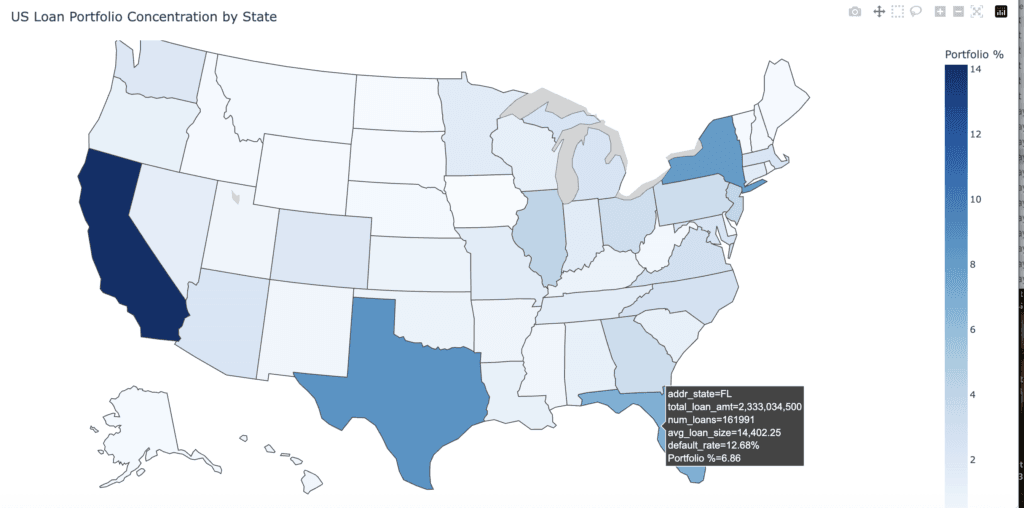
Use Case 1: Advanced Portfolio Risk Management
The Hidden Danger of Concentration Risk
Traditional portfolio analysis focuses on obvious diversification metrics: geographic spread, sector allocation, credit grade distribution. But hidden concentrations often lurk beneath surface-level diversification.
Consider a commercial loan portfolio that appears geographically diverse, loans across 15 states, 8 industries, multiple property types. Traditional analysis shows acceptable concentration levels.
But deeper analysis reveals a problem:
35% of the portfolio has exposure to commercial real estate
60% of those CRE loans are in secondary markets dependent on remote work patterns
These markets are all vulnerable to the same macro factor: corporate return-to-office policies
A single policy shift by major employers could cascade through seemingly unrelated loans, creating concentrated losses that traditional HHI (Herfindahl-Hirschman Index) calculations missed entirely.
How AI Platforms Detect This
Modern AI analytics platforms like Terno, approach concentration risk through multi-dimensional analysis:
Step 1: Automated Feature Engineering The system analyzes loan characteristics across 100+ dimensions:
Geographic location (down to ZIP code level)
Industry codes and sub-sectors
Collateral types and values
Borrower employment patterns
Economic dependencies
Supply chain relationships
Step 2: Network Analysis Rather than treating loans as independent, the AI maps interconnections:
Shared suppliers or customers
Common geographic dependencies
Correlated economic drivers
Overlapping collateral markets
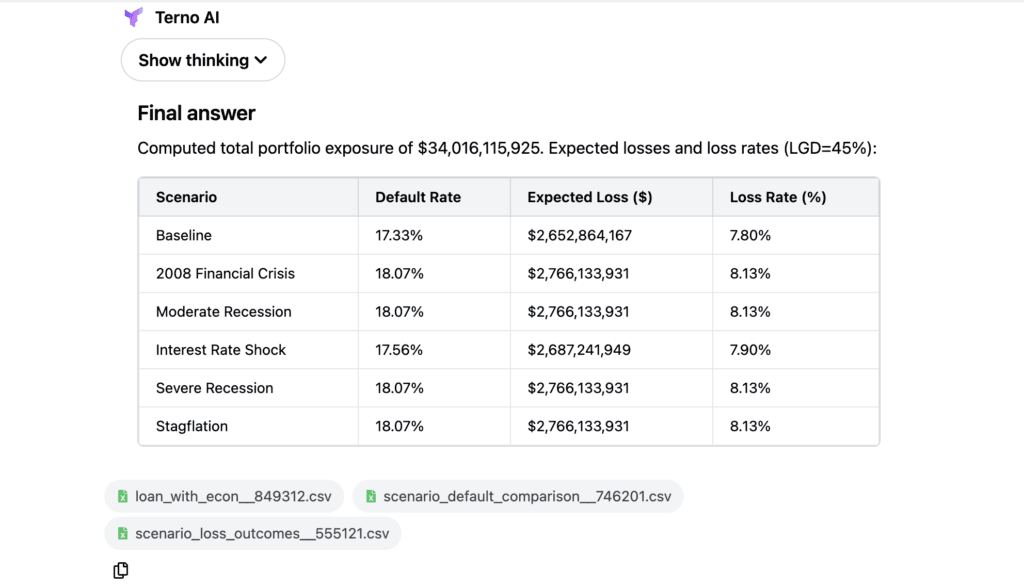
Step 3: Scenario Stress Testing The platform simulates how various shocks propagate through these networks:
Interest rate increases
Sector-specific downturns
Geographic economic shocks
Supply chain disruptions
Real Results: A mid-sized regional bank used this approach to discover that 22% of their portfolio had hidden exposure to a single auto manufacturer through various supply chain connections, a concentration 3x higher than their risk limits allowed.
They restructured $450M in lending relationships, preventing what would have been catastrophic losses when that manufacturer announced factory closures 8 months later.
Use Case 2: Predictive Credit Risk Modeling
Traditional credit scoring relies heavily on historical patterns and static variables: credit history, income, employment status. These models work reasonably well in stable economic conditions but break down during market transitions.
The Challenge: Dynamic Risk Assessment
Consider two borrowers with identical credit scores and income:
Borrower A: Software engineer at a stable tech company, $120K salary, $300K mortgage
Borrower B: Restaurant manager, $120K salary, $300K mortgage
Traditional models rate these identically. But forward-looking AI analysis reveals vastly different risk profiles:
Borrower A's industry has 5% unemployment even in recessions
Borrower B's industry saw 30% job losses during COVID-19 and remains volatile
Borrower A's income is largely fixed salary with high recession resilience
Borrower B's income includes variable bonuses tied to discretionary spending patterns
An AI platform analyzing broader economic indicators, industry trends, and behavioral patterns would flag these differential risks, enabling dynamic pricing and proactive portfolio management.
Implementation Approach
Data Integration: The AI platform connects to multiple data sources:
Internal: Transaction history, payment patterns, account activity
External: Bureau data, economic indicators, industry trends
Alternative: Employment verification, income stability signals
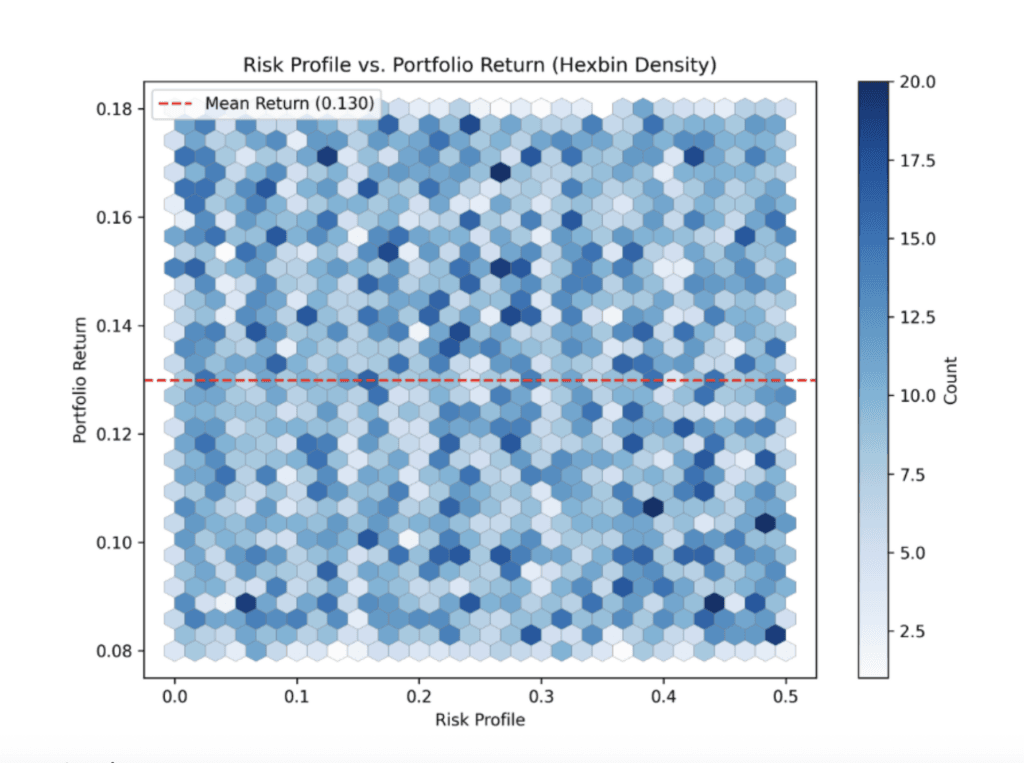
Model Training: Using historical default data, the system builds predictive models that identify leading indicators:
Payment timing patterns (paying exactly on due date vs. early = stress signal)
Account balance volatility
Credit utilization changes
Cross-product behavior
Continuous Learning: As new data arrives, the model updates risk scores in real-time, enabling:
Dynamic credit limit adjustments
Proactive outreach to at-risk customers
Portfolio-level early warning systems
Real Results: A digital lending platform implemented AI-powered risk models and achieved:
23% reduction in default rates
35% faster loan approval times
$12M in prevented losses over 18 months
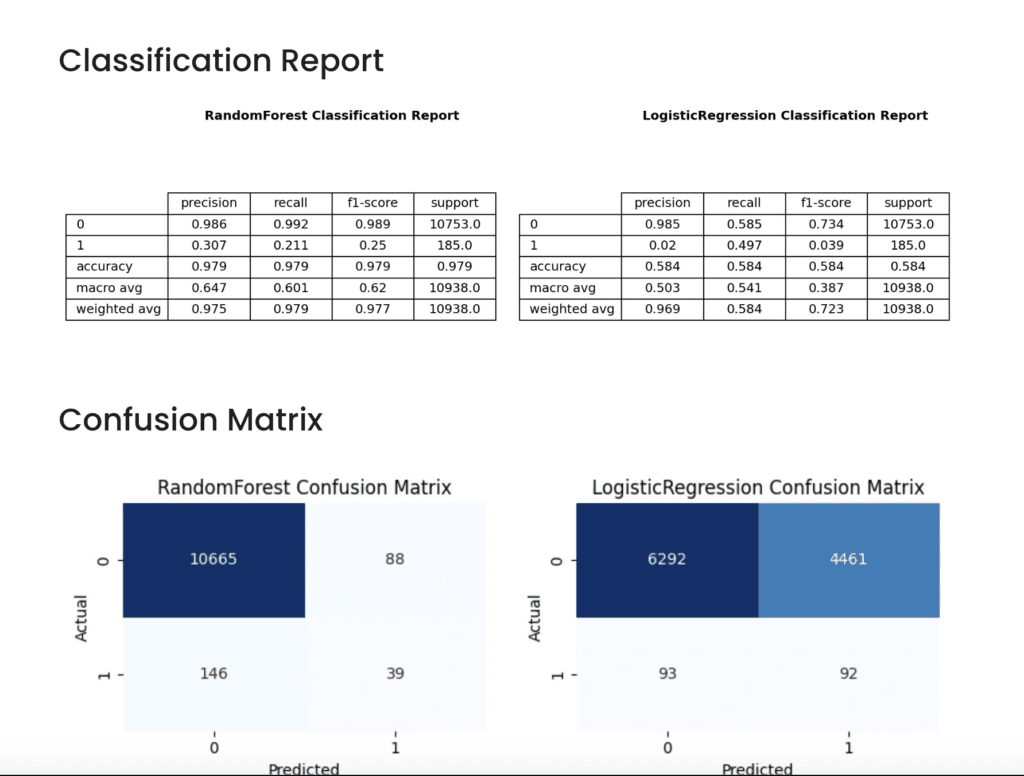
Use Case 3: Fraud Detection and AML Compliance
Financial fraud has become increasingly sophisticated. Modern fraud rings use AI themselves to identify vulnerabilities, making traditional rule-based detection systems obsolete.
The Arms Race in Fraud Detection
A typical fraud detection system uses static rules:
Flag transactions over $10,000
Alert on multiple transactions from different locations
Monitor sudden spending pattern changes
Sophisticated fraudsters easily circumvent these:
Breaking large transactions into smaller chunks (structuring)
Using VPNs to mask location changes
Gradually escalating transaction sizes to avoid threshold triggers
How AI-Powered Detection Works
Behavioral Baseline Modeling: The AI learns normal patterns for each customer across dozens of dimensions:
Transaction timing (when do they typically transact?)
Merchant categories (what do they buy?)
Geographic patterns (where do they spend?)
Device fingerprints (what devices do they use?)
Peer group comparisons (how do similar customers behave?)
Anomaly Detection: When new transactions occur, the AI calculates a multi-dimensional anomaly score:
How unusual is this transaction given this customer's history?
How unusual is this pattern compared to peer groups?
Are there correlation patterns that suggest coordinated fraud?
Network Analysis: The system maps relationships between accounts to detect fraud rings:
Shared devices or IP addresses
Similar transaction patterns
Connected merchants or recipients
Timing correlations
Adaptive Learning: As fraud patterns evolve, the system updates its detection models automatically, staying ahead of new attack vectors.
Real Results: A payments processor implemented AI fraud detection and:
Reduced false positive rates by 73% (better customer experience)
Detected 2.4x more actual fraud cases
Identified 12 organized fraud rings totaling $18M in prevented losses
Cut fraud investigation time from 45 minutes to 6 minutes per case
Use Case 4: Regulatory Reporting and Compliance Automation
Financial institutions spend enormous resources on regulatory compliance. Large banks employ hundreds of people just to prepare quarterly stress tests and regulatory reports.
The Regulatory Reporting Burden
Consider CECL (Current Expected Credit Loss) reporting requirements:
Manual Process:
Extract loan data from core banking system (1 day)
Gather macroeconomic scenario data (1 day)
Run models for each scenario (2-3 days)
Compile results into regulatory format (1-2 days)
Review and validation (2-3 days)
Total time: 7-10 days, 3-4 FTE effort
With AI Automation:
Schedule automated runs
System pulls latest data automatically
Models execute across all scenarios
Reports generate in regulatory format
Validation checks run automatically
Total time: 2 hours, 0.1 FTE effort
Implementation Details
Data Pipeline Automation: The AI platform connects directly to source systems:
Core banking platforms
Data warehouses (Snowflake, BigQuery)
Economic data feeds (FRED, Bloomberg)
Previous report archives
Scenario Engine: Pre-configured regulatory scenarios:
CCAR stress testing frameworks
Basel III capital adequacy calculations
IFRS 9 / CECL loss forecasting
Dodd-Frank reporting requirements
Audit Trail: Every calculation is logged with:
Data sources and timestamps
Model versions and parameters
Assumption documentation
Validation test results
Real Results: A regional bank automated their quarterly stress testing:
Reduced preparation time from 240 hours to 8 hours
Eliminated $400K in annual consulting fees
Improved accuracy (zero regulatory findings in 18 months)
Freed 2 FTEs to focus on strategic analysis
The Business Case: ROI of AI Analytics in Finance
Financial executives need to justify technology investments with clear ROI. Here's how leading institutions are calculating the value of AI analytics platforms:
Direct Cost Savings
Labor Cost Reduction
Average data analyst salary: $95K
Average data scientist salary: $145K
Typical institution employs 5-15 analytics professionals
AI platforms reduce need by 40-60%
Annual savings: $300K – $1.2M
Consulting and External Services
Regulatory consulting: $150K – $500K annually
Ad-hoc analytics projects: $100K – $300K annually
Model validation services: $75K – $200K annually
AI platforms reduce these by 60-80%
Annual savings: $200K – $800K
Risk Reduction Value
Fraud Prevention
Industry average fraud loss: 0.08% of transaction volume
$1B in annual transactions = $800K in fraud losses
AI detection reduces losses by 60-70%
Annual value: $480K – $560K
Improved Credit Decisions
1% reduction in default rate on $500M portfolio
Average loss-given-default: 45%
Annual value: $2.25M
Regulatory Compliance
Average regulatory fine for reporting errors: $1M – $10M
AI automation reduces violation risk by 80%+
Risk-adjusted value: $800K – $8M
Revenue Enhancement
Faster Decision-Making
Reducing loan approval time from 5 days to 2 hours
30% increase in application completion rates
15% increase in origination volume
Annual value: Varies by institution size, typically $2M – $10M
Better Customer Segmentation
10% improvement in marketing efficiency
5% increase in cross-sell success
20% reduction in customer acquisition cost
Annual value: $500K – $3M
Total ROI Example: Mid-Sized Regional Bank
Investment:
Platform license: $150K annually
Implementation services: $75K one-time
Training and change management: $50K one-time
Total first-year investment: $275K
Returns:
Labor cost savings: $450K
Reduced consulting: $200K
Fraud prevention: $500K
Improved credit decisions: $1.2M
Faster origination: $3M
Total first-year value: $5.35M
ROI: 1,845% Payback period: 2.1 weeks
Looking Forward: The Next Evolution of Financial AI analytics
The current generation of AI platforms represents a major step forward, but innovation continues:
Emerging Capabilities
Autonomous Workflows: AI agents that don't just answer questions but execute multi-step processes, from detecting a risk to updating exposure limits to notifying stakeholders.
Federated Learning: Enabling institutions to benefit from collective intelligence while maintaining data privacy, learning from industry patterns without sharing sensitive information.
Explainable AI: Advanced visualization and reasoning transparency that allows non-technical users to understand exactly how the AI reached its conclusions.
Embedded Intelligence: AI capabilities built directly into core banking platforms, removing the need for separate analytics environments.
Strategic Implications
Financial institutions face a choice: embrace AI-powered analytics as core infrastructure, or risk obsolescence.
The winners will be those who recognize that AI isn't about replacing human judgment, it's about amplifying it. The best analysts, risk managers, and executives will be those who can ask better questions of their data and receive answers they can act on with confidence.
In an industry where trust is currency and speed is survival, the institutions that master AI analytics won't just survive, they'll define the future of finance.
Getting Started: A Practical First Step
If you're a financial executive considering AI analytics, here's the simplest path forward:
Identify one painful manual process (compliance reporting, fraud review, portfolio analysis)
Quantify the current cost (time, headcount, errors, missed opportunities)
Run a 30-day pilot with a purpose-built financial AI platforms like Terno AI.
Measure the impact (time saved, accuracy improved, insights generated)
Scale what works and iterate
The institutions winning with AI aren't those with the biggest budgets or the most data scientists. They're the ones who start with a clear problem, test quickly, and scale ruthlessly.
Early adopters are already seeing competitive advantage: being data-driven translates to faster pivots and lower risk. Research shows that companies integrating AI report double-digit improvements across metrics, as they outpace lagging competitors. For decision-makers, the message is clear: AI in fintech is no longer optional. It is the lever that delivers efficiency, agility and innovation.
Schedule a demo.
Register for our upcoming webinars to hear experts share best practices and real-world results.
Useful Links
Terno AI: https://terno.ai
**PPT link: **PPT

10 September 2026
Designing CertusAI: A Compliance-First Enterprise LLM Platform for Regulated Industries
As enterprise adoption pivots from raw model parameter scale to verifiable trust, CertusAI introduces a compliance-first LLM architecture engineered specifically for highly regulated industries. By integrating real-time PII redaction, deterministic policy enforcement, and cryptographically signed audit chains directly into the inference pipeline, CertusAI unlocks agentic AI productivity while ensuring total data sovereignty and statutory compliance.

10 September 2026
E-Commerce Return Intelligence: Analyzing Return Drivers and Predicting Purchase-Time Return
Addressing reverse-logistics friction and return-rate costs in fashion e-commerce, this study leverages the 1.37M-record ASOS GraphReturns dataset to evaluate product, pricing, and country-level return drivers. Using Terno AI for structured analysis alongside a deployed Logistic Regression baseline, the platform provides purchase-time risk scoring to power relative risk ranking, operational prioritization, and non-punitive intervention pilots.
10 September 2026
Global Food Loss Intelligence: Strategic Screening & Decision Framework
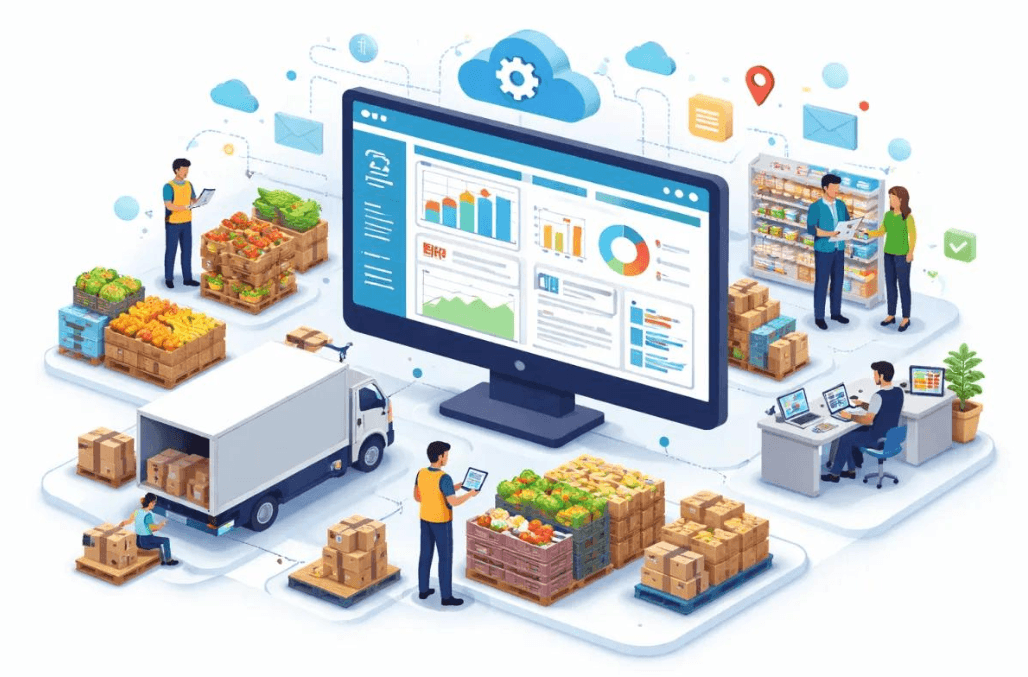
An executive decision-support whitepaper translating the official FAO Food Loss Index (SDG Indicator 12.3.1a) into actionable intelligence for 2021–2023. This study establishes a data-driven monitoring baseline across major commodity groups, identifying Fruits & Vegetables (3-year mean index of 109.65) as the primary priority for diagnostic follow-up while offering structured strategies for public policy, industry benchmarking, and evidence-based resource allocation.