Privacy-First Mule Hunter Network
A Proof-of-Concept for a Decentralised Fraud Defence System Using Federated Learning and Graph Neural Networks in Indian Banking
Read MoreMake faster decisions with your data. Terno AI helps teams explore databases using natural language, delivering instant insights without waiting on analysts or writing SQL.
A Daily, Commodity-Specific, Exposure-Weighted Geopolitical Risk Signal Built on GDELT, Validated Against Commodity Markets (2018–2026)
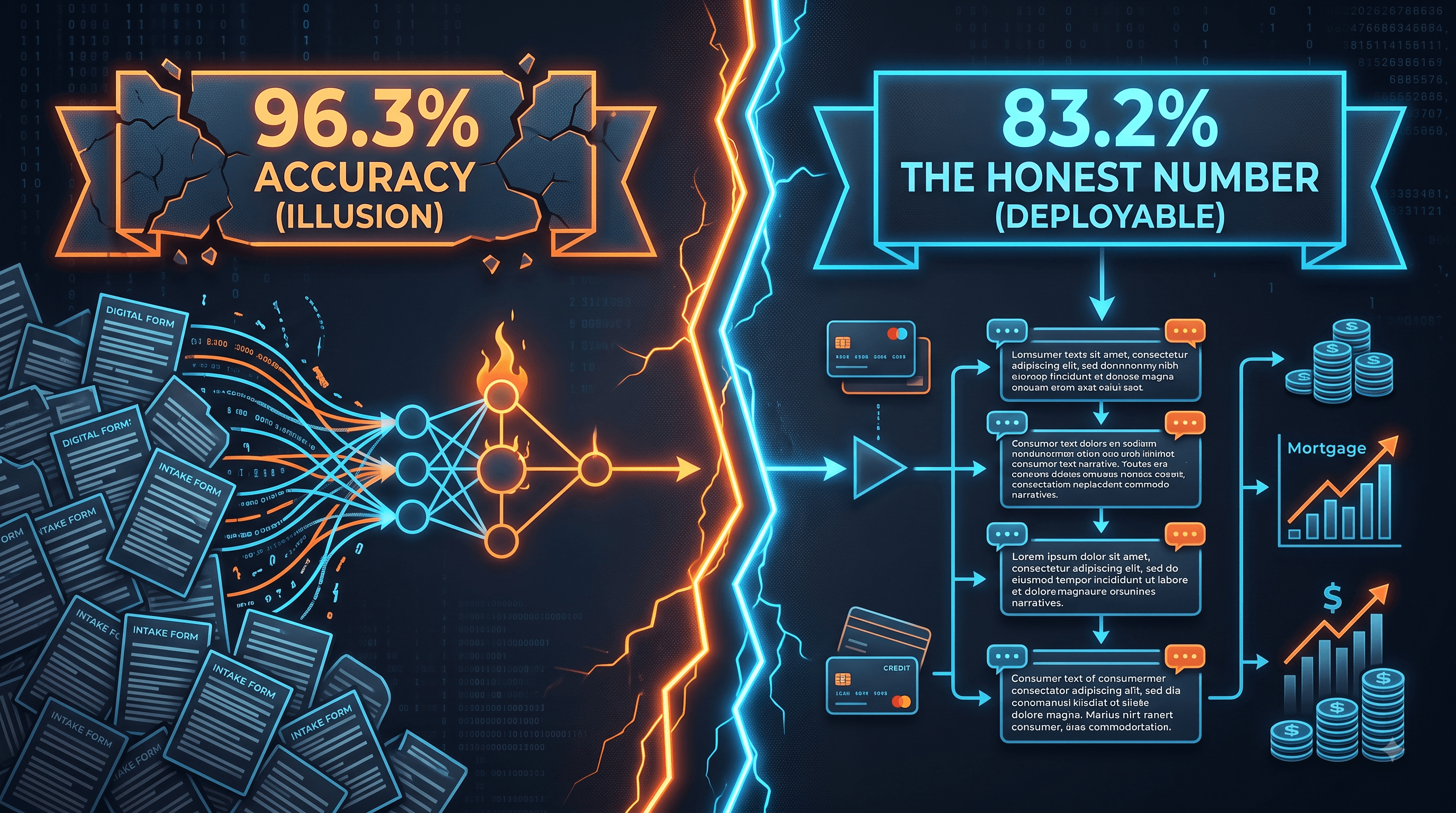
The same complaint-routing model scores 96.3% or 83.2% depending on which three columns you leave in the training data. The high number is the intake form being read back to you. This is what the leakage audit found before a single model was trained, why 83.2% is the honest figure, and how the same model — given permission to say "I don't know" — becomes deployable at 90.7% accuracy on 79.5% of traffic.
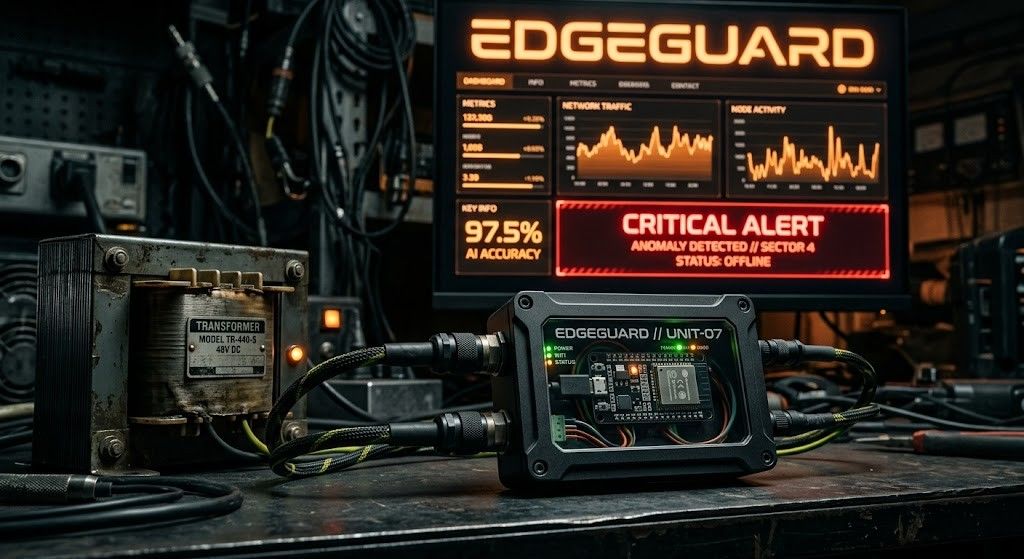
Power transformers are among the most critical assets in electrical distribution infrastructure. Their unexpected failure can result in power outages, safety hazards, equipment damage, expensive repairs, and long service interruptions. Traditional transformer maintenance practices often rely on periodic manual inspection, offline testing, or run-to-failure maintenance. These methods are expensive, slow, labor-intensive, and unable to detect rapidly developing faults in real time. EdgeGuard is an AI-driven, edge-computing predictive maintenance system designed to continuously monitor transformer health and forecast failures before catastrophic damage occurs. The system acts as a retrofittable “Digital Doctor” for distribution transformers by combining low-cost industrial sensors, an ESP32 microcontroller, local intelligence, machine learning-based risk prediction, autonomous relay control, and a real-time web dashboard. The proposed system monitors six major transformer health indicators: temperature, humidity, vibration, oil level, current, and voltage. These signals are normalized and processed through a Multi-Layer Perceptron neural network to classify transformer condition and estimate failure risk. If the predicted risk crosses a critical threshold of 80%, EdgeGuard automatically triggers a relay through GPIO 26 to isolate the transformer from the electrical network. The system also supports secure remote control, dashboard monitoring, API-key-based hardware authentication, JWT-based user access, WebSocket live updates, and automatic live-hardware detection. With an estimated deployment cost of approximately ₹3,850, EdgeGuard offers a low-cost alternative to conventional transformer monitoring systems. Its cloud-independent operation and edge-based decision-making make it especially useful for rural and semi-urban distribution grids where connectivity and maintenance resources are limited.
Analyzing 119,390 hotel bookings, this white paper shows a tuned Random Forest model beats Logistic Regression and XGBoost at predicting cancellations, powering segment-specific deposit policies and model-driven overbooking strategy.
A data-driven fraud detection framework to identify anomalous insurance claims and improve healthcare payment integrity through predictive analytics.
Analyzing 207,862 human–AI interactions, this study introduces a proxy-based framework (HRS + CEP) showing that hallucination risk and response verbosity together drive a moderate, statistically significant increase in human collaboration effort.
Analyzing 60,000 smart grid records with Terno AI, XGBoost hits 98% accuracy and a 0.998 ROC-AUC in classifying grid stability — with price elasticity and reaction-time features doing the heavy lifting.
This study shows that behavioral data alone can't reliably predict gaming toxicity — but a risk-based model combining behavioral and engineered features does a much better job of flagging the small segment of high-risk users driving disproportionate harm.
Using Terno AI's prompt-driven pipeline, an XGBoost model predicts Porter delivery times with 2.37-minute RMSE and 93.6% explained variance — turning driving duration and order congestion into a real-time ETA engine.
A machine learning framework using Terno AI benchmarks Logistic Regression, Random Forest, and XGBoost to predict clinical trial patient dropout — and shows why standardized preprocessing, not just model choice, is the key to real-world generalizability.
Scheduling Inefficiency vs. Logistics Route Failures: A Data-Driven Investigation
Analyzing 100,000 CMS collision events shows XGBoost predicts dielectron invariant mass with 0.98 R² by learning the non-linear physics that transverse momenta and electron energies encode, far outperforming linear regression's 0.41.
Get the latest insights and tutorials delivered to your inbox
Join 25,000+ data professionals already subscribed