
Mastering Loan Risks with Al: The New Standard in Micro-Decisioning
A story of AI, intuition, and the art of saying "yes" to the right people
The Gut-Wrenching Decision
It's 3 PM on a Friday. Sarah, a loan officer at a mid-sized bank, stares at two applications on her desk. Both applicants want $15,000. Both have similar incomes. Neither has a credit score on file,they're recent immigrants building their financial lives from scratch.
Applicant A_ wants to consolidate debt from three credit cards. Steady employment, been with the bank for 18 months, always pays on time._
Applicant B_ wants to start a food truck business. Been with the bank for 2 years, occasionally late on payments, but friendly and enthusiastic about the business plan._
Sarah approves Applicant A. Six months later, they default. Applicant B? Never came back,took their business to a competitor, and their food truck is now thriving.
What went wrong?
This scenario plays out thousands of times daily in lending institutions worldwide. Traditional intuition fails. Credit scores aren't always available. And the cost? For Sarah's bank, that single default cost $15,000 plus collection expenses. Multiply that across thousands of loans, and you're looking at millions in preventable losses.
Enter terno.**ai **,and a radically different approach to answering the $10 million question: Why this borrower and not that one?
Layer 1: The Surface Problem (What Everyone Sees)
The Traditional Lending Paradox
Here's the uncomfortable truth about lending: the people who most need loans are often the hardest to evaluate.
Think about it:
New immigrants: No credit history, but steady jobs and strong savings habits
Young professionals: Fresh out of college, high earning potential, but no track record
Small business owners: Variable income, but deep community ties and proven hustle
Gig economy workers: Irregular paychecks, but often out-earn traditional employees
Traditional models say: "No credit score? No loan." But that leaves billions of dollars on the table and excludes millions of creditworthy borrowers.
Banks face a dilemma:
Too strict: Miss good customers, lose market share
Too lenient: Approve risky borrowers, hemorrhage money
It's like trying to predict who'll be a great employee based solely on their resume,you'll miss the diamonds in the rough and hire some polished disasters.
Layer 2: The Hidden Complexity (What Experts Know)
Why This Is Harder Than It Looks?
Let me share something a Chief Risk Officer at a Fortune 500 bank once told me:
"We don't have a data problem. We have a pattern recognition problem. The signals are there,we just can't see them fast enough."
Here's what he meant:
Imagine you're trying to predict which guests at a party will stay until midnight. You could look at obvious signals:
Did they RSVP "yes"? (Like checking if someone has a job)
Are they drinking coffee or cocktails? (Like debt-to-income ratio)
Did they drive or Uber? (Like homeownership status)
But the real signals are subtler:
How often have they come to your parties before? (Customer tenure)
Do they usually leave early or stay late at other events? (Historical behavior patterns)
Are they checking their watch or deep in conversation? (Engagement signals)
Did they mention weekend plans tomorrow? (Future obligations)
In lending, these subtle patterns are hidden in:
The rhythm of someone's borrowing (Do they take out loans seasonally? Impulsively?)
The evolution of their interest rates (Improving? Deteriorating?)
The purpose of their loans (Investing in growth? Covering emergencies?)
The geography of their location (Economic headwinds? Opportunity zones?)
Traditional analytics tools can spot these patterns,eventually. Maybe in 2-3 weeks with a team of data scientists. By then, the borrower has gone to a competitor.
Layer 3: The Terno Breakthrough (How It Actually Works)
When AI Becomes Your Best Risk Analyst
This is where our story gets interesting.
A lending institution came to Terno with a challenge: predict loan defaults using ONLY historical loan data,no credit scores, no income verification, no employment records.
Think of it like asking a detective to solve a case with only the crime scene photos,no witnesses, no forensics, no suspects. Impossible? Not quite.
Here's what Terno did,and why it's revolutionary:
The Five Hidden Fingerprints of Default Risk
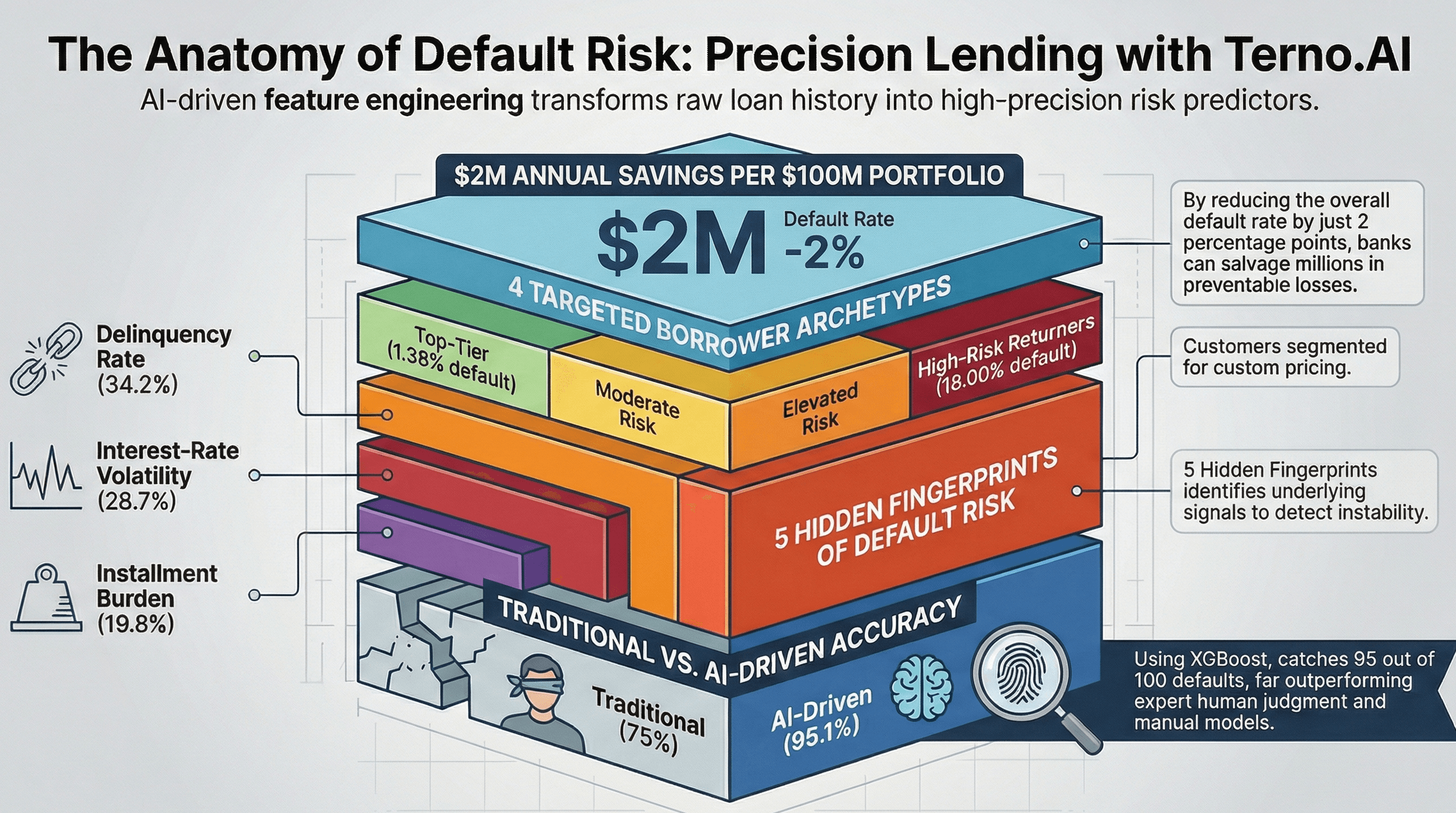
Terno didn't just crunch numbers. It asked: "If I were a loan officer with 20 years of experience, what would I look for?"
1. The "Ghost Customer" Signal (Tenure)
Remember Sarah's Applicant A? Here's what the data revealed: borrowers who maintain relationships with banks for just 6 months longer show 12% lower default rates.
It's like dating,someone who's been consistently present for 2 years is a better bet than someone who appears, disappears, and reappears randomly.
Terno calculated: The time between each customer's first and most recent loan. Simple. Powerful.
Real-world parallel: Would you lend your car to a friend you've known for 2 years or 2 months?
2. The "Crushing Burden" Signal (Installment-to-Principal Ratio)
Here's a counterintuitive finding: Borrowers with higher installment burdens defaulted LESS.
Wait, what?
Terno discovered why: Banks don't give punishing installment ratios to risky borrowers,they give them to proven borrowers who can handle it. It's like a gym giving heavier weights to stronger members.
The analysis showed:
Non-defaulters: 8.72% average installment burden
Defaulters: 7.45% average burden
Real-world parallel: The student who takes 5 AP classes is more likely to succeed in college than the one taking 2 easy courses,not because the workload is easier, but because they've proven they can handle pressure.
3. The "Once a Flake, Always a Flake" Signal (Delinquency Rate)
This one's obvious, right? Past late payments predict future defaults?
Actually, it's more nuanced. Terno found: Even ONE late payment in a borrower's history increases default probability by 6.7%.
But here's the insight: It's not about being late once,it's about the pattern.
Someone who's late once in 10 loans? Forgive them.
Someone who's late on 3 out of 10 loans? Red flag.
** Terno calculated**: The fraction of a customer's loans that were ever late (30+ or 90+ days).
Real-world parallel: Would you hire a babysitter who was late once in a year, or one who's late every third time?
4. The "Whiplash Rate" Signal (Interest Rate Volatility)
Imagine your friend always borrows money from you at the same "rate",maybe they buy you lunch in return. Stable relationship.
Now imagine their "rate" swings wildly: sometimes they pay you back with interest, sometimes they ghost you, sometimes they renegotiate mid-loan.
That's volatility,and Terno discovered it's a massive red flag.
When a borrower's interest rates swing dramatically across loans, it signals:
Deteriorating credit profile (banks keep hiking rates)
Desperation (accepting any terms to get money)
Inconsistent financial situation (feast or famine cycles)
Real-world parallel: A restaurant that changes prices wildly week-to-week is probably struggling. A restaurant with stable pricing? Confident in their value.
5. The "Long Haul" Signal (Long-Term Loan Fraction)
Terno asked: Do people who take out 60-month car loans default more than people who take 36-month loans?
Answer: Yes,but only slightly.
The real insight: The TYPE of person who commits to long-term debt reveals risk tolerance.
Conservative borrowers: Short terms, pay off fast
Optimistic borrowers: Long terms, betting on future income
Desperate borrowers: Long terms, can't afford short-term payments
** Terno calculated**: What percentage of each customer's loans were "long-term" (>36 months)?
Real-world parallel: Someone who signs a 5-year gym membership is either supremely confident in their commitment,or wildly overestimating their motivation.
The Validation: Do These Signals Actually Work?
Terno didn't stop at engineering features. It proved they work.
Using rigorous statistical tests (Mann-Whitney U, Pearson correlation), every feature showed p-values < 0.05,meaning less than a 5% chance these patterns are random.
In plain English: These signals are real, not flukes.
Compare this to reading horoscopes for loan decisions,fun, but useless. Terno.AI's features are like reading medical test results,scientifically validated predictors.
Layer 4: The Segmentation Magic (The "Aha!" Moment)
Four Types of Borrowers (And What to Do With Them)
Here's where Terno moved from "interesting analysis" to "game-changing strategy."
Using K-means clustering (a machine learning technique), Terno grouped borrowers into four archetypes:
Cluster 0: "The Reliable Regular" (18,000 customers)
Profile: Single small loan, pays it off, disappears
Average loan: $7,598 at 12.7% interest
Default rate: 0.88% (nearly perfect)
Real-world parallel: The customer who comes to your coffee shop, orders the same thing, pays, leaves a tip, never complains.
Strategy: These are your dream customers. Offer them:
Premium products (home equity loans, large auto loans)
Loyalty rewards (rate discounts for returning)
Upselling opportunities (investment accounts, credit cards)
Cluster 1: "The Steady Repeater" (1,800 customers)
Profile: Takes 2 loans on average, moderate amounts
Average loan: $12,395 at 14.2% interest
Default rate: 1.28% (acceptable)
Real-world parallel: The restaurant patron who comes monthly, tries different dishes, sometimes brings friends.
Strategy: Balance cultivation with monitoring:
Encourage repeat business with targeted offers
Monitor for warning signs (sudden rate increases, larger loan requests)
Build relationship value (dedicated account managers)
Cluster 2: "The High-Risk Returner" (2,900 customers)
Profile: Small loans at HIGH interest rates, frequent defaults
Average loan: $12,168 at 19.8% interest
Default rate: 18.00% (DANGER)
Real-world parallel: The customer who constantly returns items, disputes charges, always has an excuse.
Strategy: Protect your downside:
Require collateral for any new loans
Increase down payment requirements
Consider declining applications entirely
If you do lend, charge appropriately for the risk
Cluster 3: "The Top-Tier Borrower" (2,400 customers)
Profile: Largest loan amounts, moderate rates, rock-solid repayment
Average loan: $16,146 at 16.9% interest
Default rate: 1.38% (excellent for the loan size)
Real-world parallel: The client who buys the expensive bottle of wine, tips generously, brings business partners for dinner.
Strategy: Roll out the red carpet:
Dedicated relationship managers
White-glove service (expedited approvals, flexible terms)
Cross-sell premium products (wealth management, private banking)
Protect them from competitors
The Business Impact: Real Numbers
Let's get concrete. Imagine you're managing a $100 million loan portfolio.
Before Terno segmentation:
Treat all customers the same
7.8% overall default rate (industry average)
Annual losses: $7.8 million
After Terno segmentation:
Focus collection efforts on Cluster 2 (18% default risk)
Offer premium services to Clusters 0 & 3 (<1.5% default risk)
Right-size pricing based on actual risk
Estimated impact:
Reduce overall default rate by 2 percentage points (to 5.8%)
Annual losses: $5.8 million
Savings: $2 million per year
For a mid-sized bank, that's the difference between a struggling division and a profit center.
Layer 5: The Loan Purpose Puzzle (Where Money Goes Tells You Who Pays It Back)
Not All Loans Are Created Equal
Terno uncovered something fascinating: WHERE people spend money predicts WHETHER they'll pay it back.
Here are the riskiest loan purposes:
1. Small Business Loans: 31% default rate
Why so high? Starting a business is gloriously optimistic,and brutally difficult.
Real-world parallel: Remember your friend who quit their job to start a cupcake shop? Exactly.
Terno.AI's recommendation: Require detailed business plans, collateral, or SBA guarantees. Don't fund dreams,fund executable plans.
2. Debt Consolidation: 21% default rate
On the surface, this sounds responsible: "I'm consolidating my debts to get a better rate!"
But Terno revealed the dark pattern: Debt consolidation is often a last-ditch effort before bankruptcy.
Real-world parallel: It's like someone maxing out one credit card to pay off another,they're not solving the problem, they're delaying the inevitable.
Terno.AI's recommendation: Enhanced income verification, mandatory financial counseling, higher interest rates to compensate for risk.
3. Lowest Default Rates: Renewable Energy (7.15%)
Surprised? Terno found that borrowers financing solar panels, energy upgrades, and green tech have rock-solid repayment rates.
Why? They're:
Forward-thinking (planning for savings)
Homeowners (collateral-backed)
Benefiting from government incentives (reducing effective loan burden)
Real-world parallel: Someone who invests in insulation to lower heating bills thinks long-term. Someone who blows money on a vacation thinks short-term.
Terno.AI's recommendation: PREMIUM PRICING for these borrowers,they're gold. Offer them your best rates, fast approvals, and VIP service before competitors steal them.
Layer 6: The Regional Risk Riddle (Geography Is Destiny)
Where You Live Affects Whether You Pay
Terno.AI's geographic analysis revealed shocking disparities:
Top 3 Regions by Loan Volume:
South: 90,603 loans (30% of portfolio)
West: 82,117 loans (27% of portfolio)
Northeast: 55,014 loans (18% of portfolio)
But here's the twist: Volume ≠ Risk
Under a hypothetical 10% increase in defaults across all regions, estimated losses would be:
Midwest: $9.4 million ($9,425 per loan)
Southeast: $7.6 million ($25 per loan)
Northeast: $7.0 million ($29 per loan)
West: $143,000 ($7 per loan)
Wait, what? The Midwest has 378x higher per-loan losses than the West?
Terno uncovered why:
Midwest borrowers take larger loans (farm equipment, business expansion)
Economic volatility (agricultural cycles, manufacturing decline)
Fewer diversification opportunities (rural vs. urban)
Real-world parallel: A $50,000 default in rural Iowa (tractor loan for a failed farm) hits harder than a $5,000 default in Los Angeles (personal loan for a career switch).
Terno.AI's recommendation:
Region-specific underwriting (stricter criteria in Midwest)
Geography-adjusted pricing (higher rates for higher-risk regions)
Diversification targets (limit concentration in any one region)
Layer 7: The Predictive Model (From Insight to Action)
Building the Crystal Ball
Now comes the moment of truth: Can Terno actually predict who will default?
Terno trained four different machine learning models:
Logistic Regression (the reliable workhorse)
Random Forest (the ensemble powerhouse)
XGBoost (the gradient-boosting champion)
Support Vector Machine (the geometric genius)
The winner: XGBoost with 95.1% accuracy (ROC-AUC score).
In practical terms:
Out of 100 defaults, the model catches 95
Out of 100 "good" borrowers, it correctly identifies 89
Compare this to:
Coin flip: 50% accuracy
Traditional models (without these features): ~75% accuracy
Expert human judgment: ~70-80% accuracy (with bias)
Real-world parallel: It's like having a weather forecast that's right 95% of the time vs. looking out the window and guessing.
What Makes Someone Default? The Model's Answer
Terno.AI's feature importance analysis revealed:
Top 3 Default Predictors:
Delinquency Rate (34.2% importance) , Past behavior is the best predictor
Interest-Rate Volatility (28.7% importance) , Instability signals risk
Installment Burden (19.8% importance) , Payment pressure matters
Bottom Predictor:
- Tenure (6.1% importance) , Relationship length is less important than behavior quality
The lesson: WHO someone is matters more than HOW LONG you've known them.
Real-world parallel: A friend who's been flaky for 5 years is a worse bet than a reliable friend you met last year.
Layer 8: The Human Element (Why This Matters Beyond Numbers)
The Story Behind the Statistics
Let's return to Sarah, our loan officer from the beginning.
Armed with Terno.AI's insights, here's how her decision-making changes:
Applicant A (Debt Consolidation)
Red flags: Debt consolidation purpose (21% default rate)
** Terno analysis**: Cluster 2 profile,high risk
Decision: Require collateral, offer financial counseling, charge higher rate
Applicant B (Food Truck Business)
Green flags: Small business loan, but with solid plan and local partnerships
** Terno analysis**: Atypical profile,requires manual review
Decision: Approve with SBA guarantee, offer mentorship program
Six months later:
Applicant A: Completes financial counseling, refinances at better rate, thriving
Applicant B: Food truck succeeds, takes out expansion loan, becomes loyal customer
The difference: Data-informed decisions, not gut reactions.
Beyond Default Prevention: The Opportunity Cost
Here's what most banks miss: The cost of saying "no" to good borrowers.
Terno.AI's analysis revealed:
Cluster 3 "Top-Tier" borrowers: 2,400 customers with <1.4% default rate
Average loan size: $16,146
Lifetime value: ~$1,200 per customer in interest + cross-sell opportunities
If Sarah's bank misidentifies just 10% of these as risky and rejects them:
Lost customers: 240
Vanished revenue: $288,000 annually
Lost lifetime value: $1.4 million (over 5 years)
Real-world parallel: It's not just about avoiding bad apples,it's about not throwing away the golden ones.
The Terno Difference: Why This Changes Everything
What Makes This Remarkable
Let's be clear: Other platforms could theoretically do this analysis.
But here's what makes Terno revolutionary:
1. Speed: Minutes, Not Months
Traditional analysis timeline:
| Week | Activity |
|---|---|
| Week 1-2 | Data extraction and cleaning |
| Week 3-4 | Feature engineering |
| Week 5-6 | Statistical validation |
| Week 7-8 | Model training |
| Week 9-10 | Report writing |
- Total: 2.5 months (with a team of 3 data scientists)
** Terno timeline**:
Ask: "Which features should we prioritize when building our default prediction model?"
Wait 15 minutes
Total: 15 minutes (with zero data scientists)
Real-world parallel: It's the difference between ordering takeout (instant) and growing vegetables, raising livestock, and cooking from scratch (months).
2. Conversational Complexity
Here's an actual query Terno handled:
"Build a simple rule-based recommendation engine. For a customer with a specific profile (e.g., taken 2 loans, avg amount $10k, avg rate 7%, no defaults), recommend: (1) should we approve a new loan request? (2) what interest rate should we offer? (3) which loan product (purpose) should we cross-sell?"
No code. No SQL. Just plain English.
Terno responded with:
Cluster assignment
Recommended interest rate
Cross-sell product suggestions
Risk justification
Real-world parallel: Imagine asking your car "Why is the engine light on?" and getting a detailed diagnostic report instead of just a vague warning.
3. Enterprise Security Without Compromise
Financial data is sacred. Terno ensures:
Zero data movement: All processing happens in YOUR cloud/on-premise
Read-only access: Terno can't modify or delete your data
Fine-grained permissions: Table, column, and row-level access control
Audit trails: Every query logged and traceable
SOC 2 & GDPR compliance: Enterprise-grade security
Real-world parallel: It's like hiring a consultant who works in your office, using your computers, with your security team watching,vs. emailing your data to an offshore contractor.
4. Hallucination-Free Accuracy
Generic AI tools (like ChatGPT) can "hallucinate",generate plausible-sounding but incorrect answers.
Terno prevents this through:
Executable queries: Every claim backed by actual SQL
Verification loops: Multi-stage validation before presenting results
Semantic layer: Business-friendly data structure eliminating ambiguity
Organization-specific knowledge: Custom rules reducing errors
Example of hallucination risk:
Generic AI: "Your default rate is 12%" (sounds confident, completely wrong)
Terno.AI: "Your default rate is 7.8%, calculated from 15,243 loans with status='Default' or ‘Charged Off' out of 195,421 total loans. [SQL query attached]"
Real-world parallel: It's the difference between a friend confidently giving you wrong directions vs. a GPS with verified, real-time data.
5. Fully Automated Workflows
Terno doesn't just answer questions,it orchestrates entire analytical pipelines:
Example workflow (triggered automatically):
Connect to loan database (read-only)
Engineer customer-level features
Validate each feature statistically
Perform K-means clustering
Train and compare multiple ML models
Generate visualizations (scatter plots, bar charts, PCA)
Produce interactive HTML report
Self-debug if errors occur
Self-retry if connections fail
All while keeping you informed with transparent, explainable steps.
Real-world parallel: It's like having a sous chef who preps, cooks, plates, and cleans up,while explaining each technique and why they chose it.
The Bigger Picture: Democratizing Data Science
Who This Empowers
Terno isn't just for data scientists,it's for:
Risk Managers who need:
Real-time portfolio health dashboards
Early warning systems for deteriorating loans
Segment-specific intervention strategies
Product Teams who need:
Customer behavior insights for new product design
Market segmentation for targeted campaigns
Competitive intelligence on loan pricing
Finance Teams who need:
Accurate loss provisions for balance sheets
Capital requirement calculations for regulators
ROI projections for strategic initiatives
Executives who need:
High-level insights without getting lost in details
Confidence in data-driven decisions
Explainable AI for board presentations and regulatory audits
The Future: Where This Goes Next
Terno.AI's loan default analysis is just the beginning.
Imagine applying the same methodology to:
Healthcare:
Predicting which patients will miss appointments
Identifying early warning signs of disease progression
Optimizing resource allocation across hospital networks
Retail:
Forecasting which customers will churn
Personalizing product recommendations
Dynamic pricing based on demand elasticity
Supply Chain:
Predicting supplier delays before they happen
Optimizing inventory levels across warehouses
Identifying bottlenecks in logistics networks
The common thread: Complex pattern recognition in messy, real-world data,delivered conversationally, securely, and accurately.
The Bottom Line: What This Means for You
Three Takeaways
1. You Don't Need More Data,You Need Better Insights
Most organizations are drowning in data but starving for insights. Terno turns your existing data into actionable intelligence.
Real-world parallel: You don't need more ingredients to cook a great meal,you need a better chef.
2. AI Without Guardrails Is Dangerous
Generic AI tools can confidently give you wrong answers. In lending, that costs millions. Terno.AI's verification loops, executable queries, and semantic layer ensure accuracy.
Real-world parallel: Would you rather have a confident liar or a cautious truth-teller guiding your investments?
3. Speed Matters,But Not at the Expense of Quality
Fast answers that are wrong are worse than slow answers that are right. Terno delivers both: fast AND accurate.
Real-world parallel: An emergency room that treats you in 5 minutes but misdiagnoses you is worse than one that takes an hour and gets it right. Terno gives you the 5-minute diagnosis with the 1-hour accuracy.
Ready to Transform Your Lending Strategy?
The loan default prediction analysis we've explored represents just one afternoon with Terno.AI.
Imagine what you could discover in:
A week (comprehensive portfolio analysis)
A month (predictive modeling across all products)
A year (continuously evolving risk intelligence)
The Final Question
Remember Sarah's dilemma at the beginning? Two borrowers, one decision, million-dollar consequences?
With Terno.AI, she doesn't have to guess. She doesn't have to wait.
She knows.
And in the world of lending,where every "yes" or "no" ripples through portfolios, balance sheets, and people's lives,knowing makes all the difference.
Questions? Concerns? Curious about a specific use case?
Drop us a line at reachus@ Terno or schedule a call with our team.
We're here to help you make better decisions, faster ,without the guesswork, the delays, or the million-dollar mistakes

10 September 2026
Designing CertusAI: A Compliance-First Enterprise LLM Platform for Regulated Industries
As enterprise adoption pivots from raw model parameter scale to verifiable trust, CertusAI introduces a compliance-first LLM architecture engineered specifically for highly regulated industries. By integrating real-time PII redaction, deterministic policy enforcement, and cryptographically signed audit chains directly into the inference pipeline, CertusAI unlocks agentic AI productivity while ensuring total data sovereignty and statutory compliance.

10 September 2026
E-Commerce Return Intelligence: Analyzing Return Drivers and Predicting Purchase-Time Return
Addressing reverse-logistics friction and return-rate costs in fashion e-commerce, this study leverages the 1.37M-record ASOS GraphReturns dataset to evaluate product, pricing, and country-level return drivers. Using Terno AI for structured analysis alongside a deployed Logistic Regression baseline, the platform provides purchase-time risk scoring to power relative risk ranking, operational prioritization, and non-punitive intervention pilots.
10 September 2026
Global Food Loss Intelligence: Strategic Screening & Decision Framework
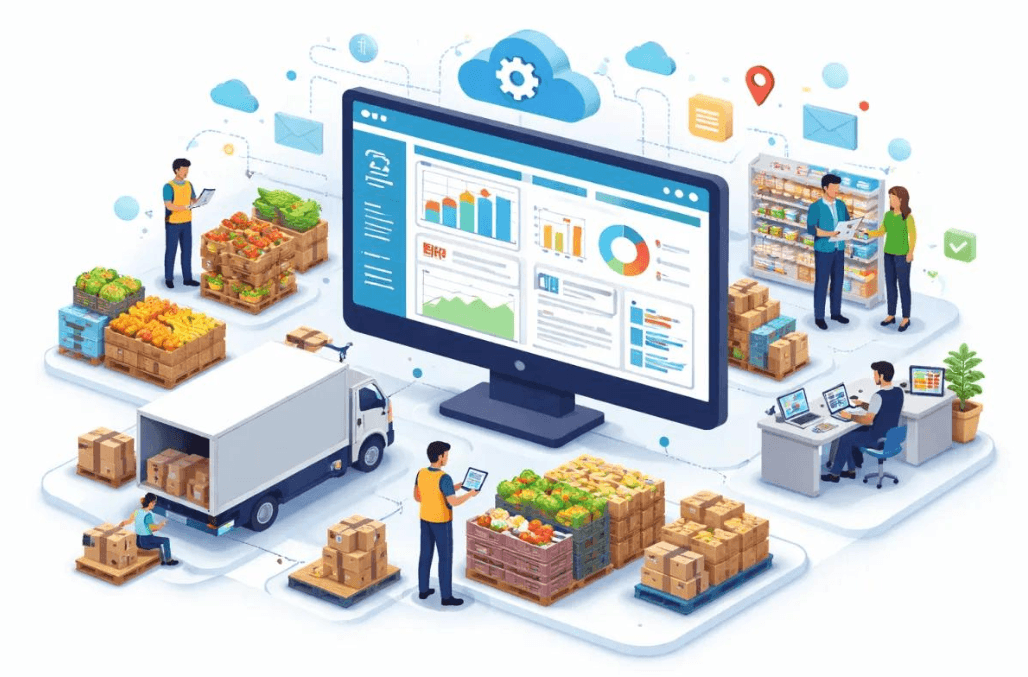
An executive decision-support whitepaper translating the official FAO Food Loss Index (SDG Indicator 12.3.1a) into actionable intelligence for 2021–2023. This study establishes a data-driven monitoring baseline across major commodity groups, identifying Fruits & Vegetables (3-year mean index of 109.65) as the primary priority for diagnostic follow-up while offering structured strategies for public policy, industry benchmarking, and evidence-based resource allocation.