Understanding Key Factors Affecting Health Insurance Premium Using Terno AI
Are You Paying Too Much for Insurance? A Data-Driven Look
Ever wondered why your insurance bill looks the way it does? In this study, we set out to uncover how different demographic and personal factors—like age, lifestyle, and income—impact insurance charges. The goal is simple: to help you figure out whether you’re actually paying a fair amount.
Table of Contents
Data Source
Why is Insurance Important?
Questions to Answer
Goals
Concepts
Tools
Method
Data Analysis Using Terno AI
Evaluation
From Questions to Answers
Challenges Identified by Terno AI
Recommendations by Terno AI
Conclusion
Data Source
Why is Insurance Important?
Life is unpredictable, and that’s what makes** insurance **such an essential financial safety net. Health insurance, for example, helps protect your savings when unexpected medical expenses arise. Instead of draining your hard-earned income during tough times, the right policy steps in to cover the costs.
But it’s not just about having insurance—it’s about understanding the factors that matter when choosing a plan. By knowing what drives insurance charges, you can make smarter, more informed decisions that truly protect your future.
Questions to Answer
Which feature is the **strongest reason **for the premium?Is **BMI a key factor **in insurance premiums?Between **age and smoking habit**, which has a stronger relationship with the premium?Does **taking insurance early** help in reducing the premium amount?
Goals
Understand the **key factors** affecting insurance premiums.**Predict** our insurance premium levels based on our data.
Concepts
BMI (Body Mass Index)
BMI is used to assess whether a person has a **healthy body** weight for their height.Categorize individuals as underweight, normal weight, overweight, or obese.Formula: BMI = **Weight (kg)** / **Height (m)2**
BMI Range
| BMI Value | Category |
|---|---|
| Less Than 16 | Severely underweight |
| 16.0 - 16.9 | Moderately underweight |
| 17.0 - 18.4 | Mildly underweight |
| 18.5 - 24.9 | Normal weight |
| 25.0 - 29.9 | Overweight |
| 30.0 - 34.9 | Obese Class I (Moderate) |
| 35.0 - 39.9 | Obese Class II (Severe) |
| 40.0 & Above | Obese Class III (Very severe) |
Tools
Terno AI
Terno AI is a secure, conversational AI-Powered Data Scientist that helps you make fast, accurate insights using natural language tailored to your data. It is a very useful tool for data solutions that save time and help you focus on more important matters. Uncovering trends and patterns from data is a tedious process when we do it manually. But for Terno AI, it's just a walk in the park. We will see how Terno AI makes our work easy and fast, while being accurate and error-free.
Now that we have the data, we start our process. This is where **Terno AI** comes in. Generally, we have to clean each column, ensure data consistency, and preprocess the data manually ourselves.
Connect to Dataset
Next, we connect to the downloaded dataset by uploading the CSV file to Terno AI.
Prompt to Terno AI
Now we ask Terno AI to make an analysis and a prediction using the prompt:
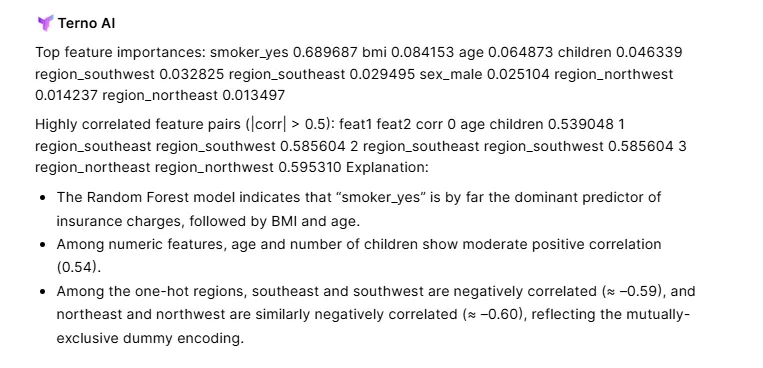
Prompt: Use the Nebil Divay_ds_4 insurance_records with columns age,sex,bmi,childrem smoker,region and charges. Generate a prediction model using this dataset and understand the key features that contribute to the charges. Also, give information on which are the features that are closely related to each other
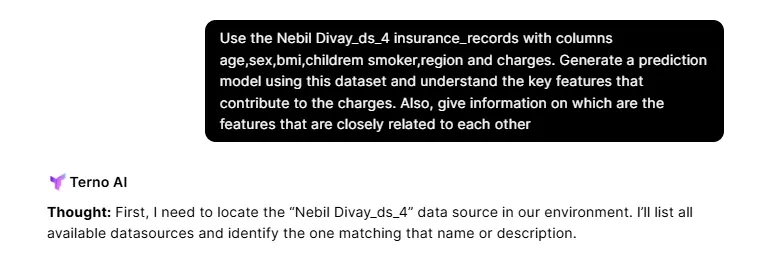
Terno Response:
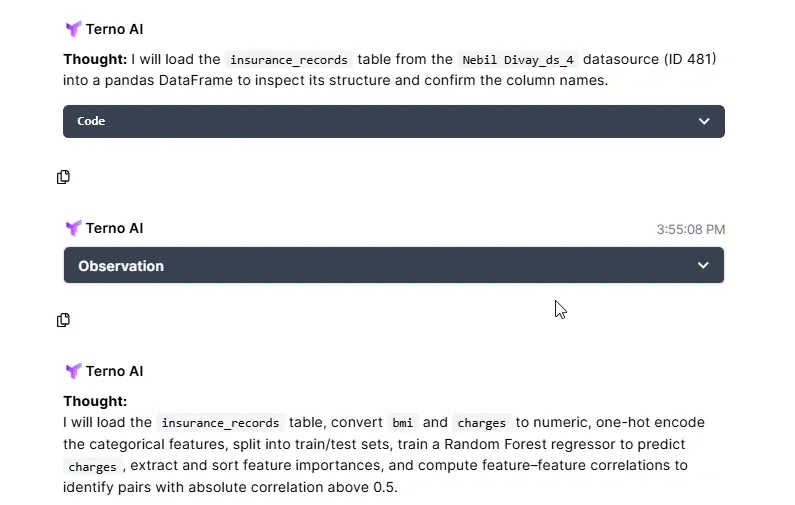
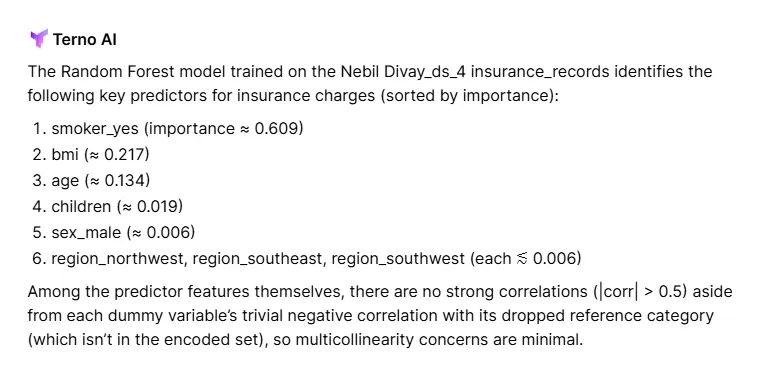
Findings by Terno AI
Data Analysis Using Terno AI
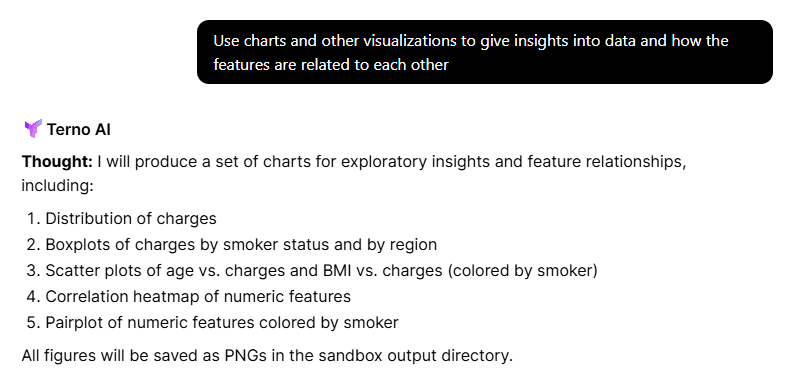
We will use data analysis to understand the structure of data, find **relationships **between features, and derive any insights that can help in making informed decisions. Just like before, we give a prompt to Terno AI in simple English and let Terno AI do its thing.
Prompt: Use charts and other visualizations to give insights into data and how the features are related to each other
Distribution of Insurance Charges
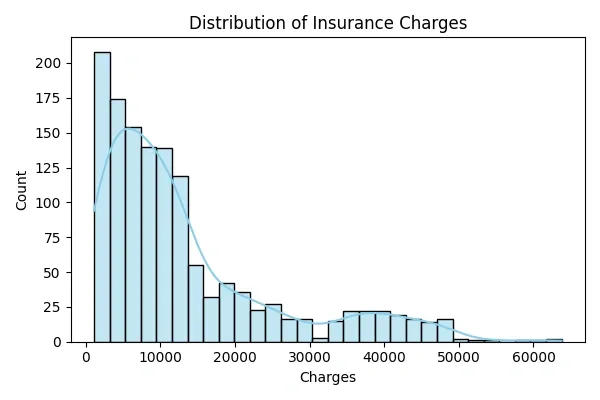
Charges are right-skewed, with most policyholders paying below $20 000, but a long tail up to over $60 000.
Charges by Smoker Status
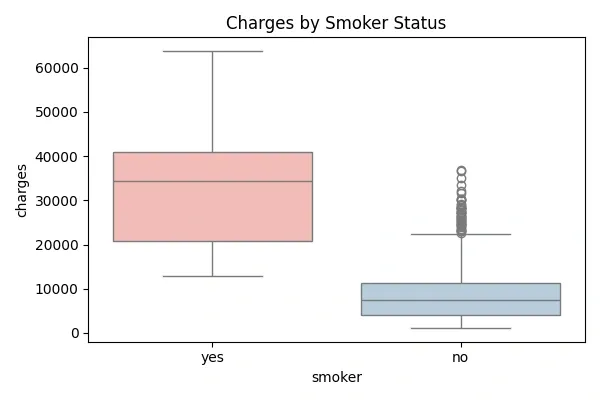
Smokers (red) incur dramatically higher and more variable charges than non-smokers (green).
Charges by Region
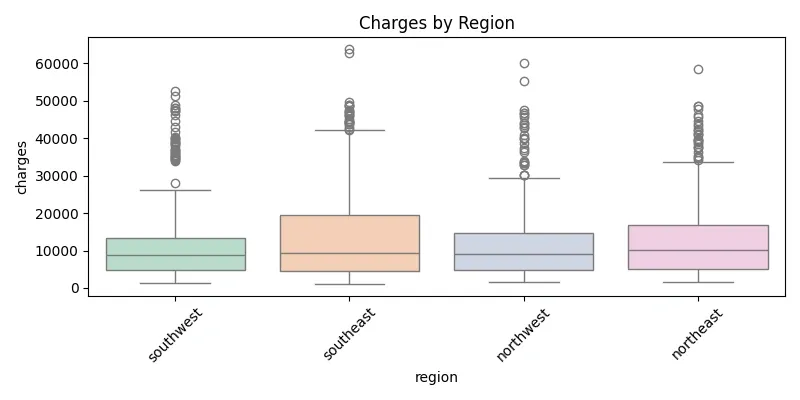
Median charges are roughly similar across regions, though the southwest and southeast show slightly wider spreads.
Age vs. Charges (Colored by Smoker)
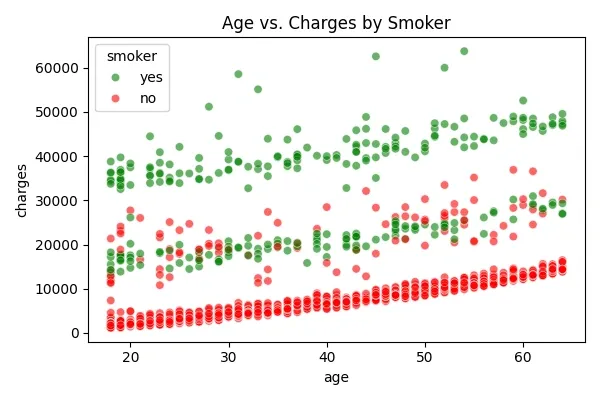
Older smokers tend to have the **highest **charges; for non-smokers, age has a milder upward trend.
BMI vs Charges (Colored by Smoker)
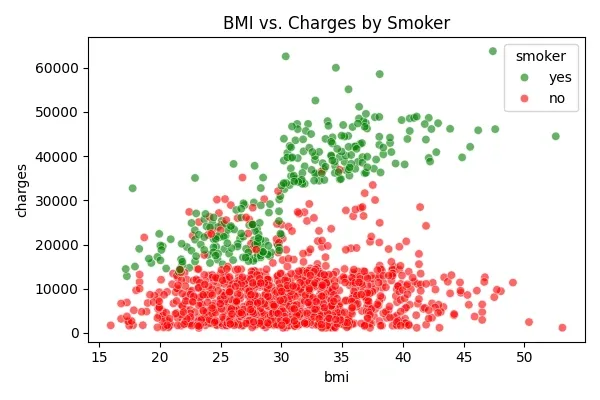
High-BMI smokers face the highest costs, while among non-smokers, the BMI–charges relationship is much weaker.
Correlation Heatmap (Numeric Features)
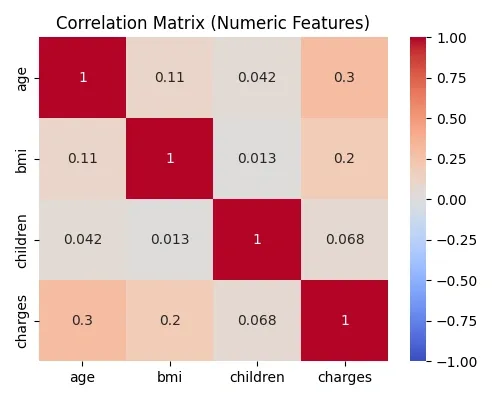
Age and number of children show a moderate positive correlation.
Charges correlate strongly with the smoker flag and moderately with BMI and age.
Pair plot of Numeric Features by Smoker
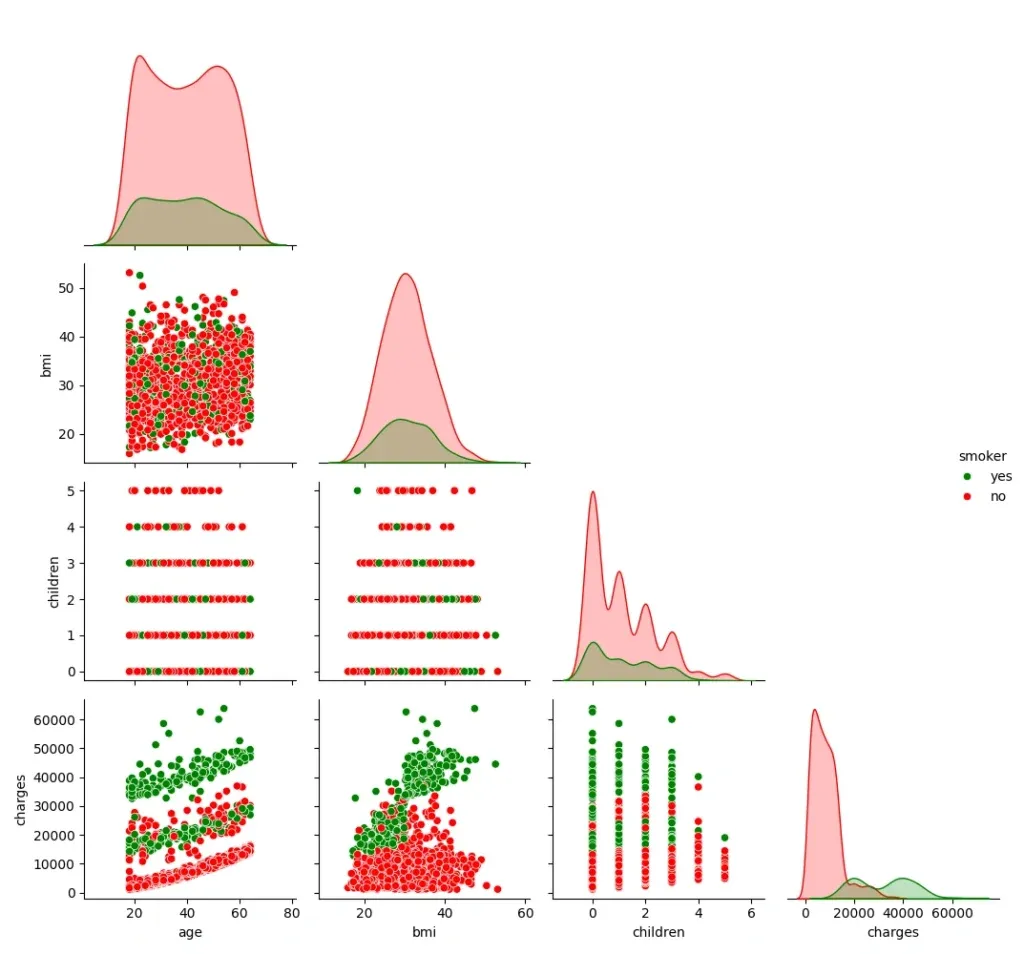
The pairwise panels confirm: smoker status drives most of the spread in charges; age and BMI each show mild joint effects.
Evaluation
Prompt: Give images of classification report and feature importance for the same
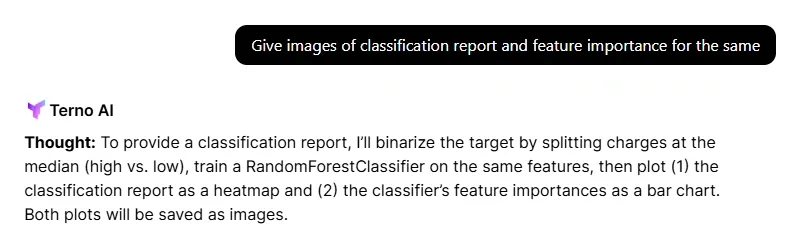
Classification Report
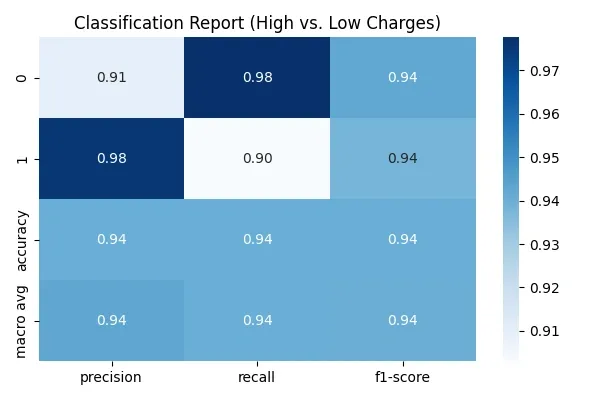
As per the classification report, we can see that the model has a good accuracy of 94%.
The precision and recall are also above 90% for both low & high premiums.
The numbers clearly show that this is a** reliable model** to make predictions on our premium levels.
Feature Importance
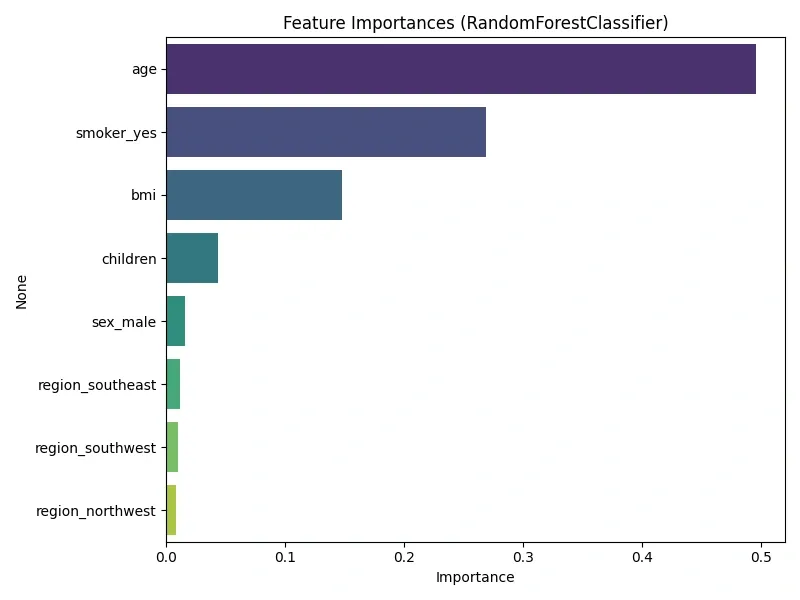
The Random Forest model identifies the following key predictors for insurance charges;
Age
Smoker_yes
BMI
Children
Sex_male
Region_southeast, Region_southwest, Region_northwest
****
From Questions to Answers
Which feature is the strongest reason for the premium?
Smoker status_ is by far the __strongest _driver of cost.
Is BMI a key factor in insurance premiums?
_BMI and age _are secondary predictors with positive relationships to charges.
Btw age and smoking habits, which has a stronger relationship with the premium?
Smoker status is by far the strongest driver of cost. ** **
_ _Does taking insurance early help in reducing the premium amount?
Taking out insurance early can help lower the premium amount
Challenges Identified by Terno AI
Terno AI was not only able to** generate insights** into our problem but also identify some of the challenges with the overall project and provided appropriate suggestions.
- The dataset does not include features like** alcohol consumption, premedical history, existing medical condition,** etc., which also influence insurance premiums.
Recommendations by Terno AI
Terno AI gave us the following recommendations to help us reduce our insurance premium amount. What’s interesting to note here is that these are actually very practical and useful recommendations we can implement in real life. So, the findings can give stakeholders a clear direction to take action.
Taking out insurance early can help lower the premium amount.
Implement robust smoking cessation programs to reduce overall charges.
Focus on weight-management interventions, particularly for current smokers.
Tailor healthcare cost controls in high-charge regions (e.g., the southeast).
Conclusion
We keep saying, AI is the future, but the truth is, it is already here. It is making our work fast, easy, and accurate. **Terno AI** is simply the **best **when it comes to AI Data Scientist models; it helped us complete hours of work in a matter of a few seconds. Please see the full chat link here.
It also helped us uncover hidden insights from data, which would have been very difficult to find otherwise. The recommendations and insights given by Terno AI were both **actionable and practical. **
**So, do you want to do it the old way or the Terno AI** way? The choice is yours !!

10 September 2026
Designing CertusAI: A Compliance-First Enterprise LLM Platform for Regulated Industries
As enterprise adoption pivots from raw model parameter scale to verifiable trust, CertusAI introduces a compliance-first LLM architecture engineered specifically for highly regulated industries. By integrating real-time PII redaction, deterministic policy enforcement, and cryptographically signed audit chains directly into the inference pipeline, CertusAI unlocks agentic AI productivity while ensuring total data sovereignty and statutory compliance.

10 September 2026
E-Commerce Return Intelligence: Analyzing Return Drivers and Predicting Purchase-Time Return
Addressing reverse-logistics friction and return-rate costs in fashion e-commerce, this study leverages the 1.37M-record ASOS GraphReturns dataset to evaluate product, pricing, and country-level return drivers. Using Terno AI for structured analysis alongside a deployed Logistic Regression baseline, the platform provides purchase-time risk scoring to power relative risk ranking, operational prioritization, and non-punitive intervention pilots.
10 September 2026
Global Food Loss Intelligence: Strategic Screening & Decision Framework
An executive decision-support whitepaper translating the official FAO Food Loss Index (SDG Indicator 12.3.1a) into actionable intelligence for 2021–2023. This study establishes a data-driven monitoring baseline across major commodity groups, identifying Fruits & Vegetables (3-year mean index of 109.65) as the primary priority for diagnostic follow-up while offering structured strategies for public policy, industry benchmarking, and evidence-based resource allocation.