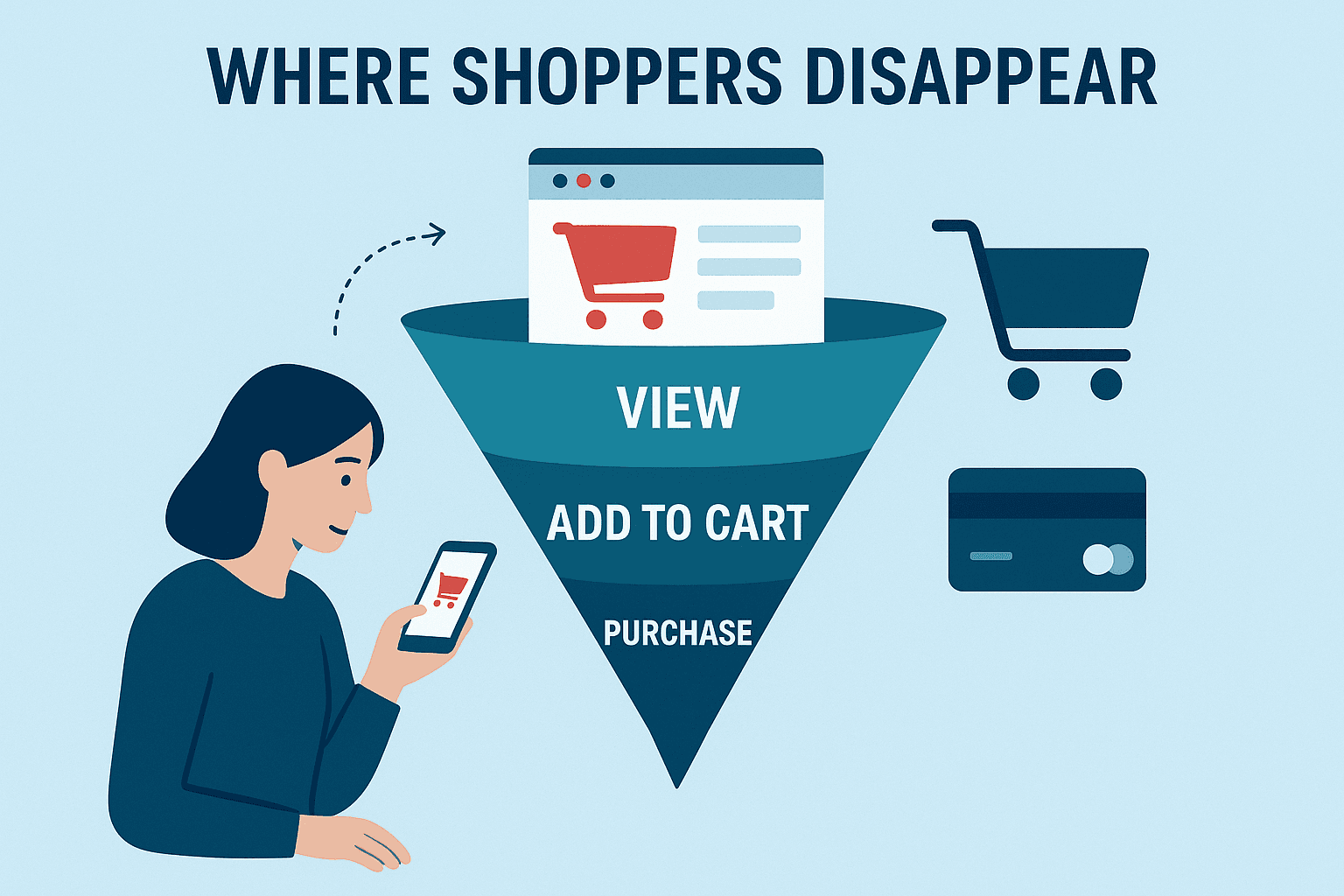
Introduction: Understanding the Digital Shopper
Every e-commerce business thrives on one core journey: users view a product, add it to their cart, and—ideally—complete the purchase. But somewhere along that path, a significant portion of shoppers fall off.
My goal was simple:
Identify where shoppers drop off and why.
Instead of writing SQL or stitching together dashboards, I used TernoAI, a no-code analytical assistant that understands natural-language commands. Throughout this analysis, I asked TernoAI a series of prompts, and it returned complete, accurate insights within seconds.
Step 1: Reconstructing the Funnel
To begin, I asked:
Prompt:
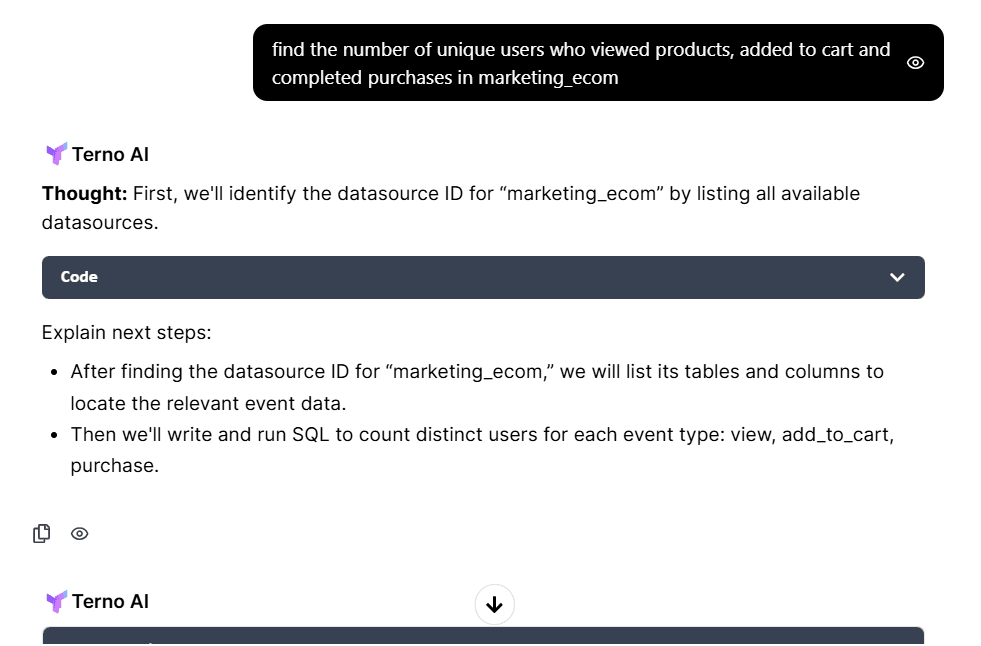
“Find the number of unique users who viewed products, added to cart, and completed purchases in marketing_ecom.”
TernoAI scanned the datasource and returned the key funnel stages:
| Funnel Stage | Unique Users |
|---|---|
| Viewed Product | 79,995 |
| Added to Cart | 79,995 |
| Purchased | 27,380 |
Immediately, two insights became clear:
1. Interest is strong.
Every user who viewed a product also added it to their cart—an extremely positive sign for product discovery and catalog quality.
2. Checkout is the problem.
Despite perfect engagement up to the cart, only one-third completed their purchase.
This is the main break point in the funnel.
Step 2: Measuring Conversion at Each Stage
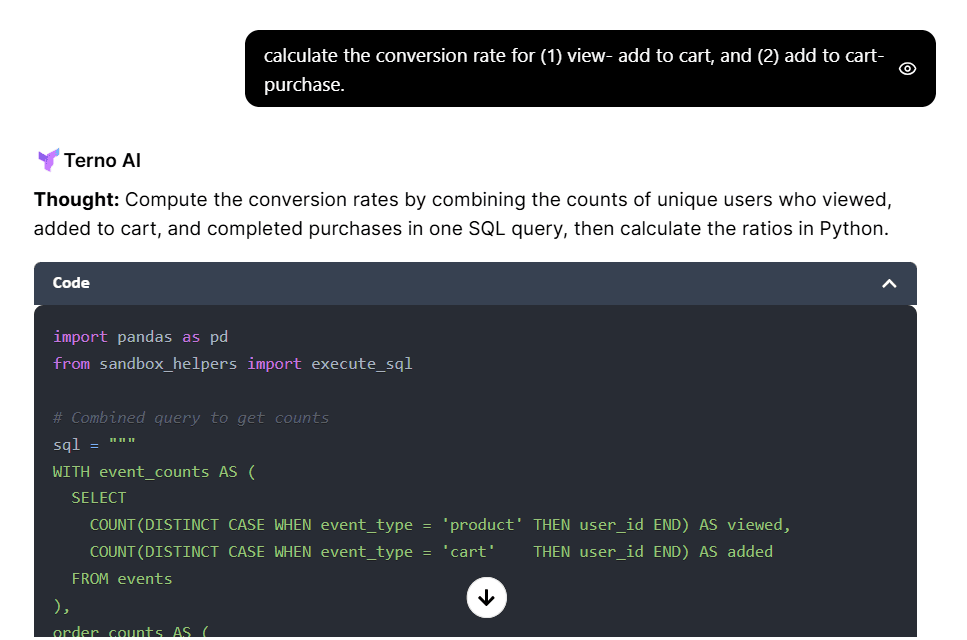
To quantify exactly how effectively users move from one stage to another, I prompted:
Prompt:
“Calculate the conversion rate for (1) view–add to cart, and (2) add to cart–purchase.”
The results were:
| Step | Conversion Rate |
|---|---|
| View → Add to Cart | 100% |
| Add to Cart → Purchase | 34.23% |
This clearly shows that while product pages are performing exceptionally well, the checkout process is losing 66% of users.
From a business perspective, this is where optimization efforts will have the highest revenue impact.
Step 3: Which Age Groups Convert the Best?
To understand user behavior more deeply, I asked:
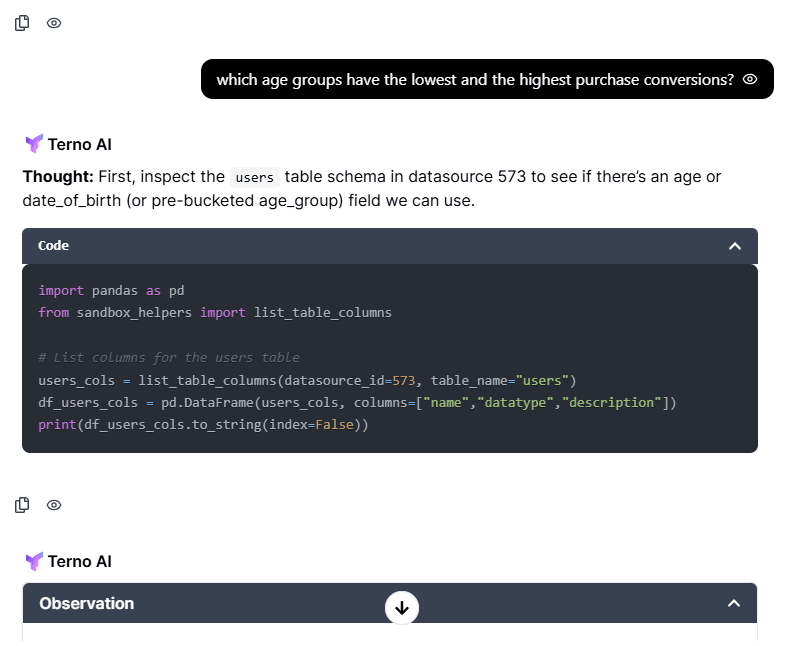
Prompt:
“Which age groups have the lowest and highest purchase conversions?”
TernoAI segmented users by age and analyzed their purchase behavior:
| Age Group | Conversion Rate |
|---|---|
| 18-24 | 33.59% |
| 45-54 | 34.98% |
While the difference may appear small, it reflects meaningful behavioral patterns:
Younger shoppers (18–24) explore more but hesitate during checkout—typically due to price sensitivity or lower trust.
Older shoppers (45–54) convert more consistently—suggesting clearer intent and stronger buying confidence.
This insight guides more personalized marketing strategies.
Step 4: Category-Level Performance — Where Do Users Drop Off Most?
Next, I wanted to identify whether certain product categories drive more drop-off than others.
Prompt:
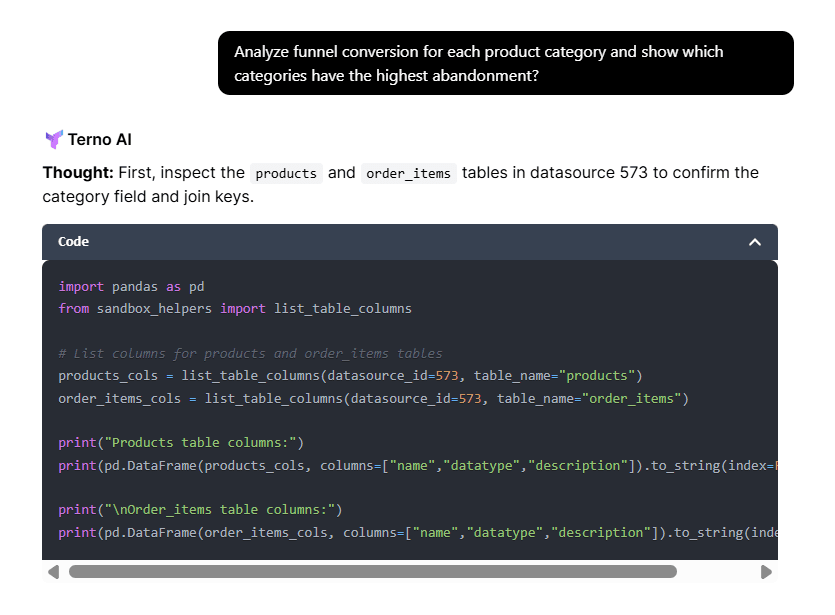
“Analyze funnel conversion for each product category and show which categories have the highest abandonment.”
Since add-to-cart events didn’t include product IDs, TernoAI analyzed view-to-purchase conversions instead.
Categories with the Highest Abandonment (~76%)
Blazers & Jackets
Clothing Sets
These categories tend to involve sizing uncertainty, higher pricing, or style risk, all common drivers of hesitation.
Categories with the Lowest Abandonment (~72%)
Underwear
Suits & Sport Coats
These items generally offer more predictable sizing, making users more confident in purchasing.
This insight is crucial for category managers, UX teams, and merchandising strategy.
Step 5: Visualizing the Funnel
To visualize the user flow, I requested:
Prompt:
“Create a funnel chart showing number of users who viewed, added to cart, and purchased.”
TernoAI generated a clean funnel chart that made the sharp drop at the purchase stage visually unmistakable—perfect for presentations or stakeholder reports.
Step 6: Turning Insights Into Action
With the funnel mapped and drop-off points identified, I asked TernoAI:
Prompt:
“Give marketing recommendations to reduce funnel drop-off and improve conversions.”
Here are the key strategies supported by the data:
1. Optimize Checkout (Top Priority)
This is the largest source of revenue loss.
Enable guest checkout
Offer fast payment methods (UPI, Paytm, Apple/Google Pay)
Display shipping fees earlier
Add trust badges (“Secure Checkout”, “Free Returns”)
Reduce checkout steps
Send abandoned-cart reminders
Even incremental improvements here can lift conversions meaningfully.
2. Strengthen Confidence in High-Abandonment Categories
Especially Blazers, Jackets, and Clothing Sets.
Enhanced size and fit guidance
More photos of models with height/fit details
Real customer reviews with images
Clear, flexible return policies
Fit-prediction tools
Reducing uncertainty leads to higher conversions.
3. Tailor Messaging by Age Segment
For 18–24 (low conversion):
Student discounts
Buy Now Pay Later (BNPL)
Influencer-led content
Prominent return guarantees
For 45–54 (high-intent):
Premium bundles
Loyalty program rewards
Personalized recommendations
Segmentation ensures marketing feels relevant rather than generic.
4. A/B Test Key Touchpoints
A/B testing helps identify which changes truly improve conversions.
Test:
• Different checkout button text (e.g., “Complete Order” vs. “Secure Checkout”)
• Placement of trust badges, return policies, or shipping info
• One-page vs. multi-step checkout layouts
• Visibility of discounts, promo codes, or free-shipping banners
• Tone and timing of abandoned-cart reminders
Even small winning variations can create measurable lifts in conversion rates.
Conclusion: The Funnel Is a Conversation, Not Just a Metric
This analysis demonstrated how much you can uncover with the right questions.
Using TernoAI, I was able to:
Map the customer journey end-to-end
Identify the exact point of drop-off.
Compare behavior across age groups.
Understand category-level friction
Generate actionable, revenue-focused strategies.
All without writing a single line of code.
Beneath every number is a shopper making a decision.
And when we understand those decisions
We can build better, more confident buying experiences.

10 September 2026
Designing CertusAI: A Compliance-First Enterprise LLM Platform for Regulated Industries
As enterprise adoption pivots from raw model parameter scale to verifiable trust, CertusAI introduces a compliance-first LLM architecture engineered specifically for highly regulated industries. By integrating real-time PII redaction, deterministic policy enforcement, and cryptographically signed audit chains directly into the inference pipeline, CertusAI unlocks agentic AI productivity while ensuring total data sovereignty and statutory compliance.

10 September 2026
E-Commerce Return Intelligence: Analyzing Return Drivers and Predicting Purchase-Time Return
Addressing reverse-logistics friction and return-rate costs in fashion e-commerce, this study leverages the 1.37M-record ASOS GraphReturns dataset to evaluate product, pricing, and country-level return drivers. Using Terno AI for structured analysis alongside a deployed Logistic Regression baseline, the platform provides purchase-time risk scoring to power relative risk ranking, operational prioritization, and non-punitive intervention pilots.
10 September 2026
Global Food Loss Intelligence: Strategic Screening & Decision Framework
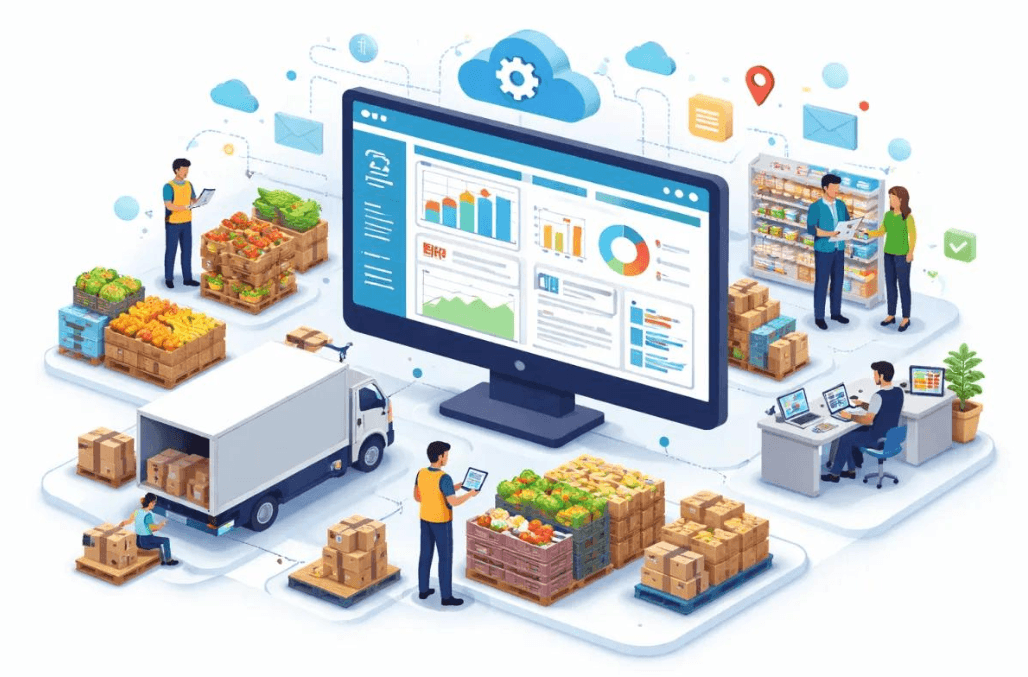
An executive decision-support whitepaper translating the official FAO Food Loss Index (SDG Indicator 12.3.1a) into actionable intelligence for 2021–2023. This study establishes a data-driven monitoring baseline across major commodity groups, identifying Fruits & Vegetables (3-year mean index of 109.65) as the primary priority for diagnostic follow-up while offering structured strategies for public policy, industry benchmarking, and evidence-based resource allocation.