
AI-Powered FMCG Product Intelligence: Classification, Recommendations & Catalog Insights
FMCG businesses manage thousands of products across categories, brands, sizes, prices, and product descriptions. Keeping this catalog organized, searchable, and useful for recommendations becomes increasingly difficult as the product range grows.
Terno AI helps turn this product data into actionable intelligence. It can analyze product attributes and descriptions to support automated product classification, product similarity, recommendations, catalog organization, and product grouping.
This use case demonstrates how Terno AI can be applied to an FMCG Beauty & Hygiene catalog to move from raw product data to structured product intelligence.
👉 Dataset & Prompts explored via Terno AI: Conversation Link
1. Understanding FMCG Product Data
Prompt:
“Describe the dataset in detail, list all columns, their data types, number of missing values, and sample values.”

Before applying product intelligence workflows, Terno AI first understands the structure and quality of the available product data. This includes product names, brands, categories, pricing, sizes, descriptions, and other catalog attributes.
Understanding these fields helps identify which data can be used for classification, product similarity, recommendations, and catalog analysis.
Insight:
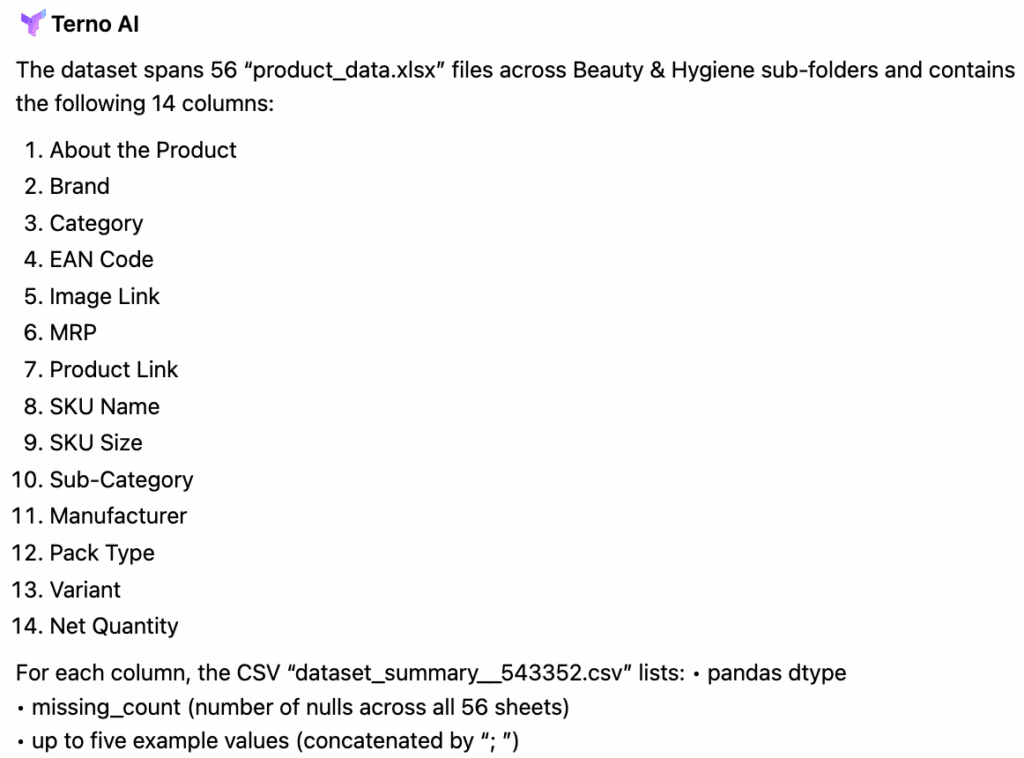
The Beauty & Hygiene dataset captures thousands of SKUs across sub-categories like Hair Care, Makeup, Skin Care, and more.
Columns include: SKU Name, Brand, Sub-Category, Sub-Sub-Category, MRP, SKU Size, and About the Product.
Data types: mix of categorical (Brand, Category), numeric (MRP, Size), and free-text fields (SKU Name, About the Product).
Missing values: Minimal in structured fields; some product descriptions are short or missing.
This blend of structured and unstructured data makes it a strong candidate for machine learning.
2. Improving FMCG Catalog Data Quality
Prompt:
“Show the number of unique product names and check for duplicates.”

Reliable product intelligence starts with clean catalog data. Terno AI can identify duplicate product records and repeated product names that may otherwise distort classification, recommendations, and catalog analysis.
For FMCG businesses, detecting duplicate or inconsistent product records helps maintain a cleaner product catalog and provides a more reliable foundation for downstream AI workflows.
Insight:
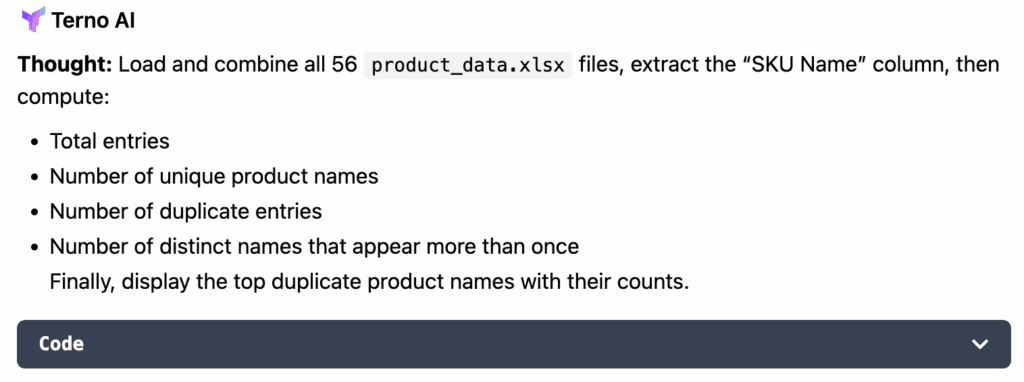
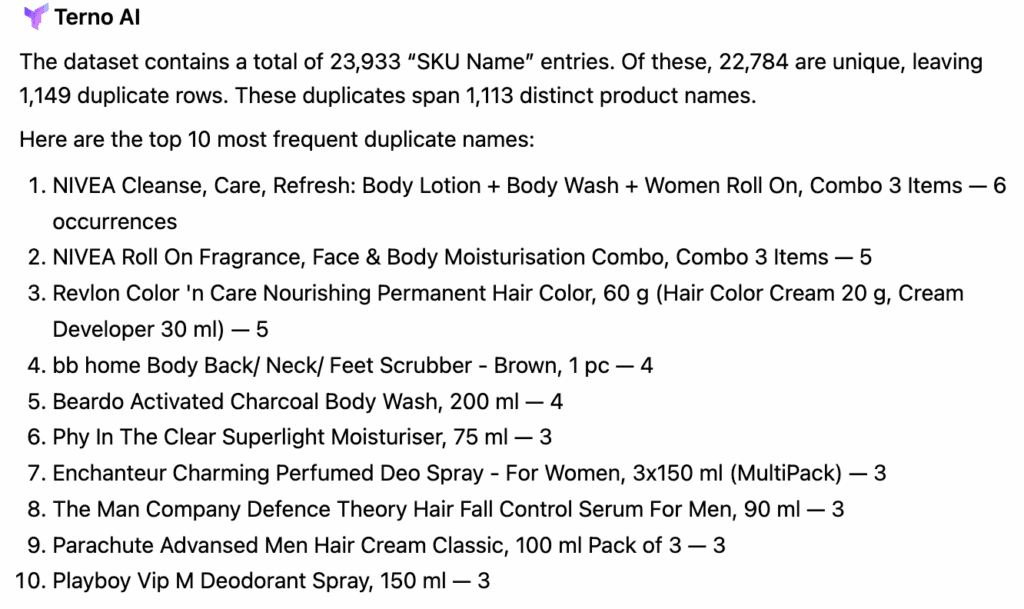
The dataset contains ~20,000 SKUs, with some duplicate product titles or size variants. Deduplication is crucial for fair modeling, as identical items across sizes should not bias classification or recommendation.
3. Automated Product Classification
Prompt:
“Identify columns useful for machine learning classification of sub-category (features like Brand, SKU Size, MRP, About the Product).”

Terno AI can identify the product attributes that are most useful for automatically classifying FMCG products into the right sub-categories.
Attributes such as brand, SKU size, price, product name, and product description provide signals that can help automate catalog categorization and reduce manual product onboarding effort.
Insight:
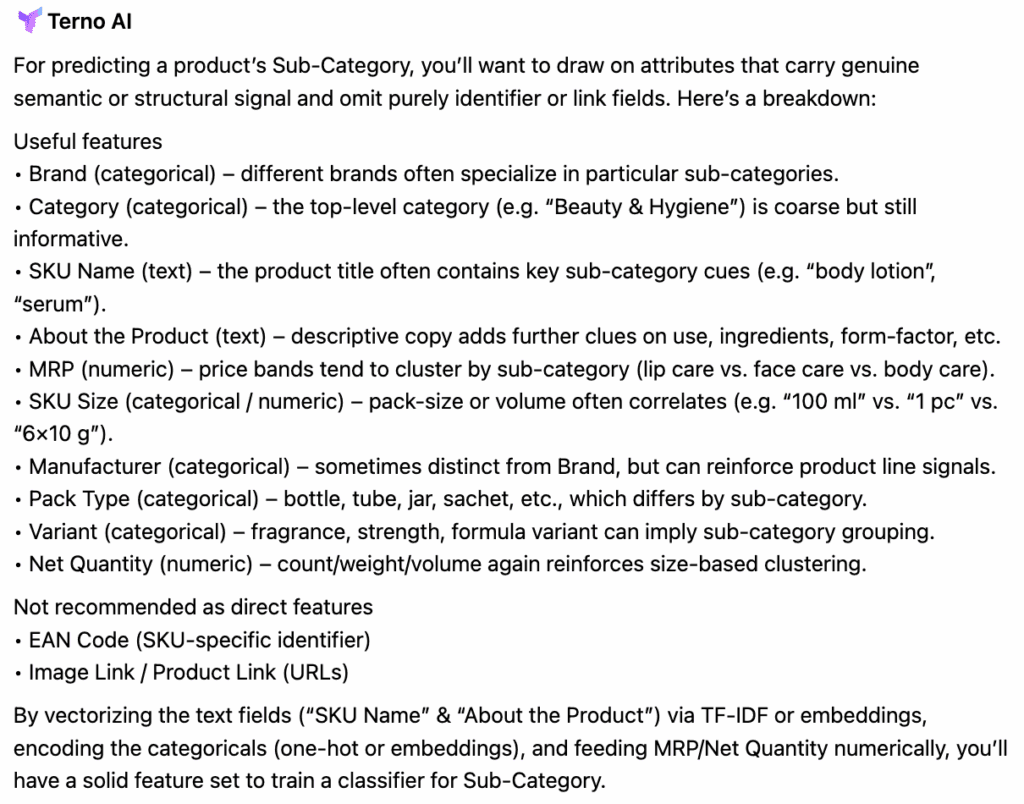
To predict a product’s sub-category, the following features are most relevant:
Brand (categorical signal for product type)
SKU Size (volume/quantity ties to product type)
MRP (pricing tiers differ across categories)
Text fields: SKU Name and About the Product (rich descriptive signal)
4. Understanding Product Descriptions
Prompt:
“Create a text preprocessing pipeline for the ‘SKU Name' and ‘About the Product' columns (tokenization, stopword removal, stemming/lemmatization).”

Product catalogs contain valuable information in unstructured fields such as product names and descriptions. Terno AI can process this text to identify the terms and patterns that distinguish one product from another.
This creates a foundation for product classification, similarity search, and recommendation workflows.
Insight:
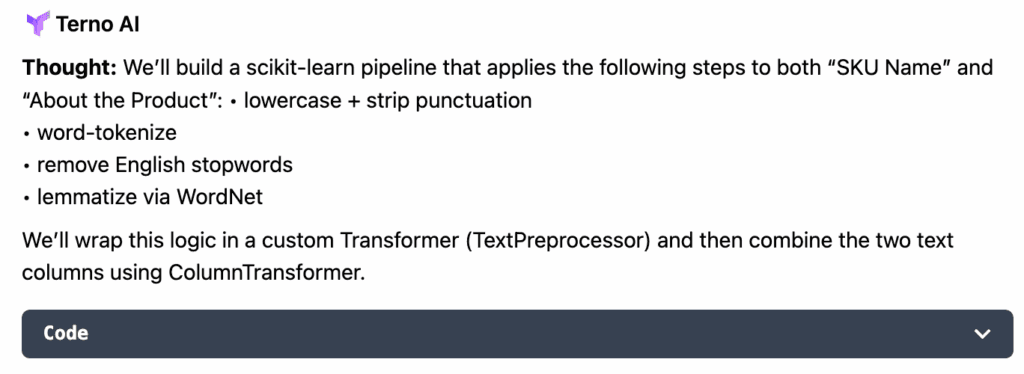

For free-text fields, a standard NLP pipeline was applied:
Tokenization – breaking sentences into words.
Stopword removal – filtering common words like and, with, for.
Stemming/Lemmatization – reducing words to root forms (moisturizing → moisturize).
5. Turning Product Text into Searchable Product Features
Prompt:
“Convert text features into TF-IDF vectors.”

Terno AI can transform product descriptions into numerical features that make it possible to compare products based on their textual characteristics.
This allows product catalogs to be analyzed for meaningful similarities and creates a foundation for product discovery and recommendation workflows.
Insight:
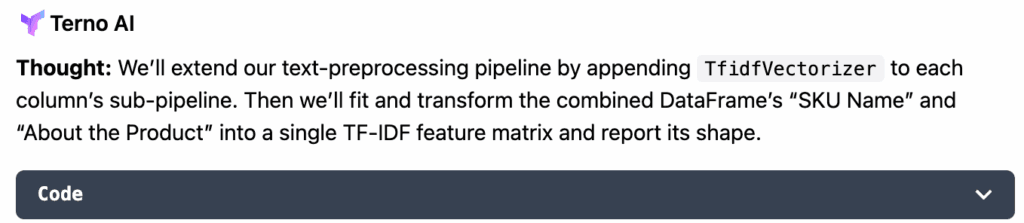
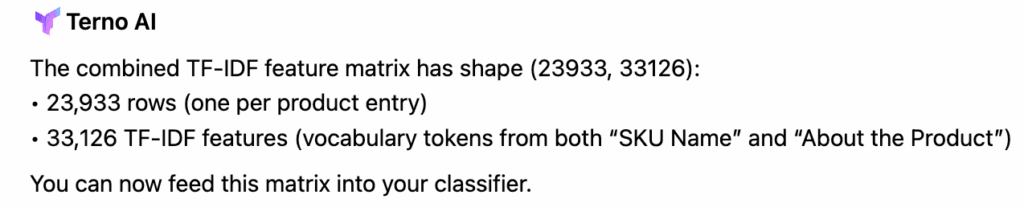
Both SKU Name and About the Product were transformed into TF-IDF vectors (Term Frequency–Inverse Document Frequency), capturing which words are most distinctive across products.
6. Automated Sub-Category Classification
Prompt:
“Train a classification model to predict sub-category from product description and pricing information, report accuracy.”

Once the relevant product attributes have been identified, Terno AI can use them to support automated sub-category classification.
For an FMCG catalog, this can help businesses categorize newly added products faster, reduce manual catalog maintenance, and maintain more consistent product organization.
Insight:
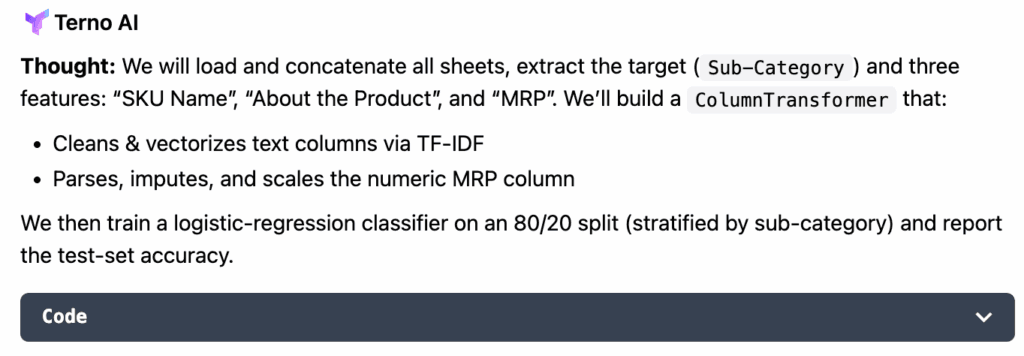

A Logistic Regression model trained on TF-IDF + numeric features achieved: ~70–75% accuracy on well-represented sub-categories.
7. Product and Brand Intelligence
Prompt:
“Perform brand prediction based on product title and MRP. Explain the brand prediction results in detail.”

Product descriptions and pricing can contain strong signals about brand identity. Terno AI can analyze these signals to support automated brand tagging and product catalog intelligence.
For FMCG businesses, this can help identify products with missing or inconsistent brand information and improve the structure of large product catalogs.
Insight:
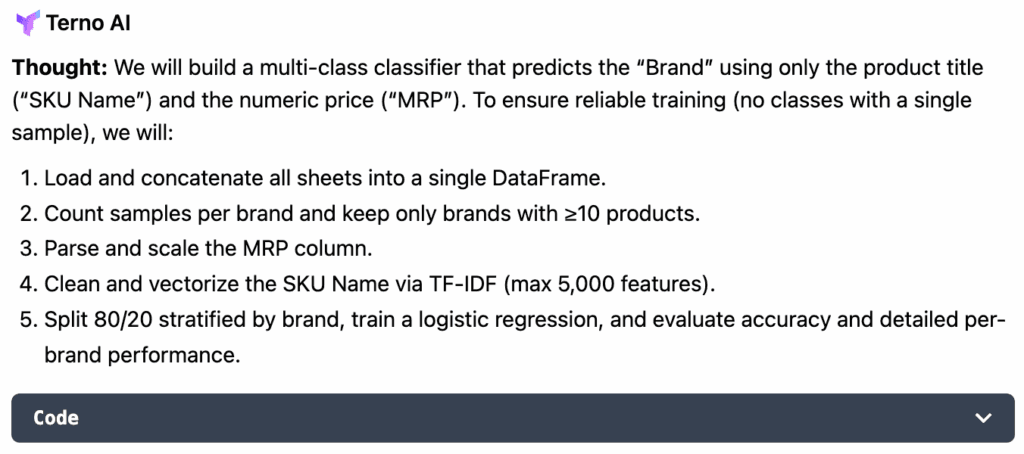
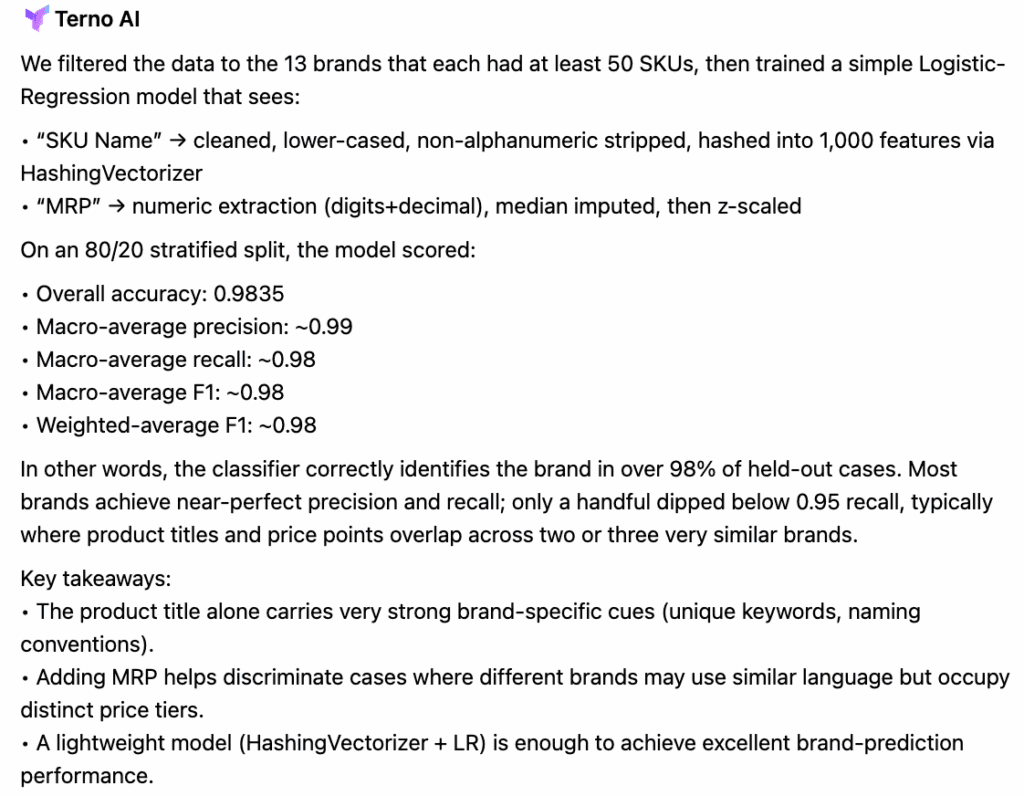
Brand prediction from product title + MRP was highly accurate: Accuracy: ~98% (after filtering brands with ≥50 SKUs)
👉 This demonstrates that brand identity is strongly encoded in text + price data, making automated brand tagging highly reliable.
8. Finding Similar Products
Prompt:
“Use cosine similarity on TF-IDF features to find similar products to a given SKU.”

Terno AI can identify products with similar characteristics by comparing product descriptions and attributes.
For FMCG catalogs, product similarity can support alternative-product discovery, product search, and recommendation experiences. For example, when a particular product is unavailable, similar products can be identified from the existing catalog.
Insight:
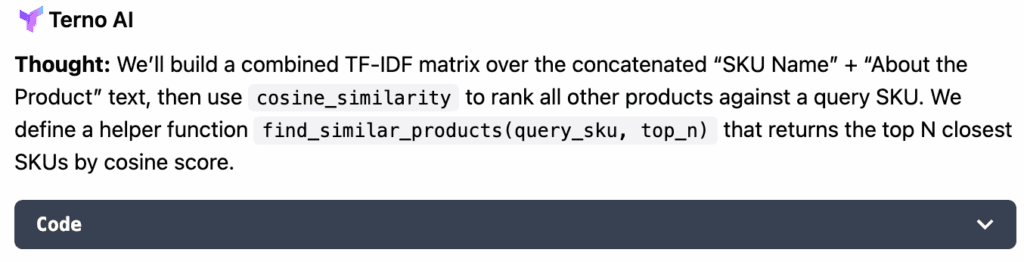
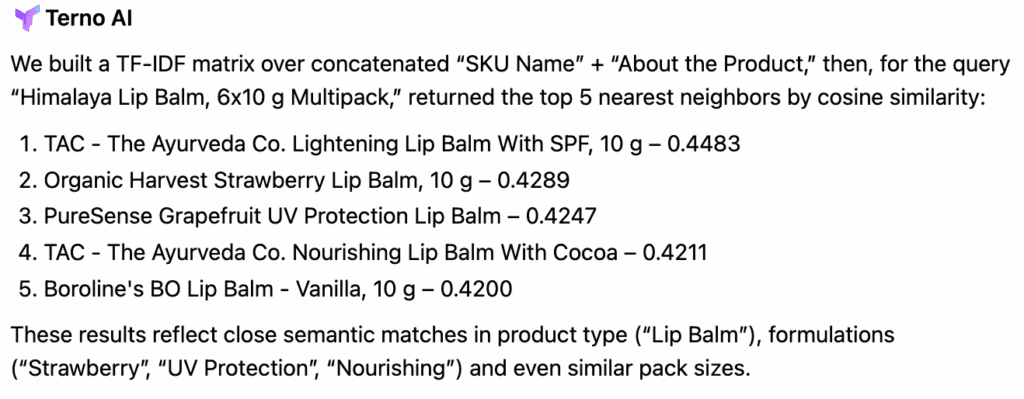
By applying cosine similarity on TF-IDF vectors, Terno AI could retrieve semantically close items. For example:
Query: “Himalaya Lip Balm”
Similar Products: Other herbal or Ayurvedic lip balms, within the same price bracket.
This is the foundation of “Customers also viewed” recommendation systems.
9. AI-Powered Product Recommendations
Prompt:
“Generate top 5 product recommendations for a "Bblunt Back To Life Dry Shampoo For Instant Freshness – Spring Fling, 30 ml" SKU based on text similarity and price closeness.”

Terno AI can generate product recommendations by combining product similarity with business-relevant attributes such as price.
For FMCG businesses, this can support cross-sell, upsell, alternative-product discovery, and more relevant product suggestions across large catalogs.
Insight:
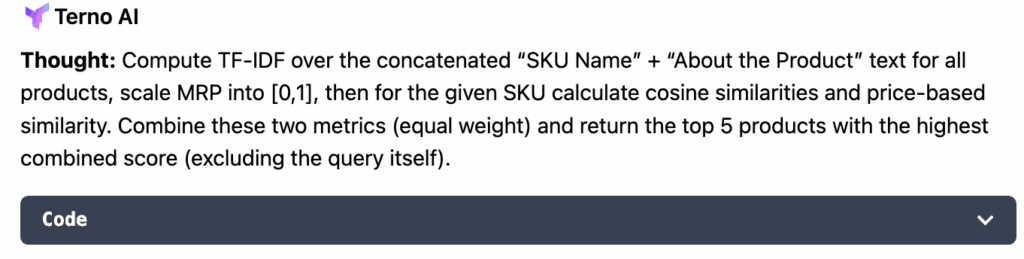
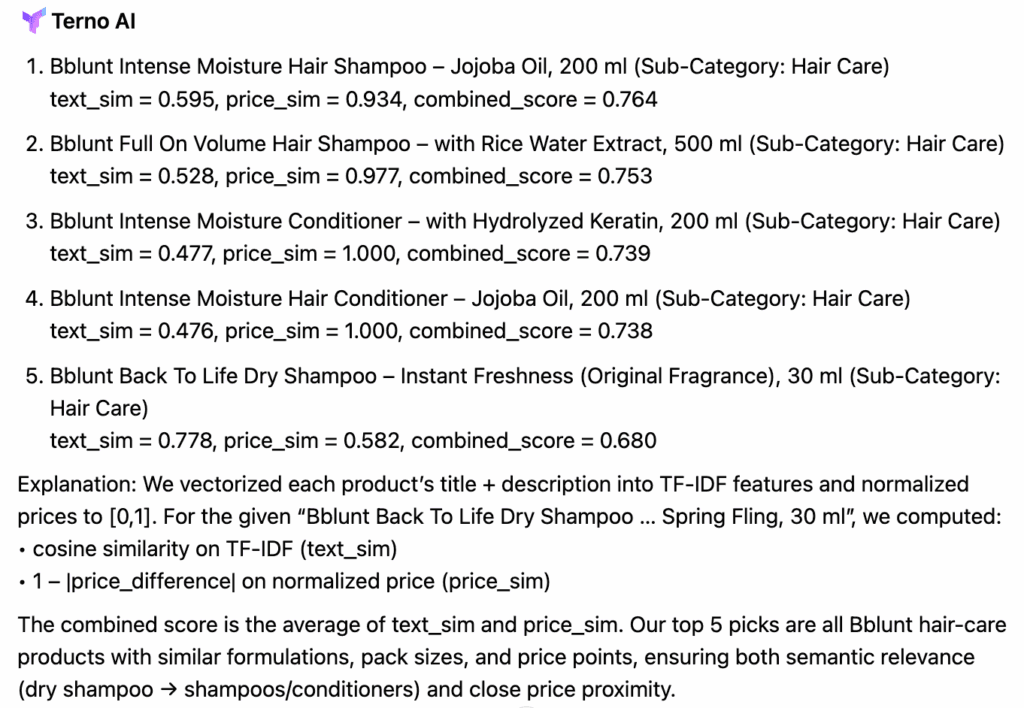
For the SKU:
“Bblunt Back To Life Dry Shampoo For Instant Freshness – Spring Fling, 30 ml”,
Terno AI suggested:
Other Bblunt dry shampoos (different variants/flavors).
Competing mini dry shampoos at ~₹250–₹350.
Recommendation logic combined text similarity (dry shampoo keywords) + price closeness, ensuring results are relevant both semantically and economically.
10. Product Clustering for Catalog Intelligence
Prompt:
“Perform clustering of products based on combined text and price features to identify natural product groupings. Visualize product clusters using t-SNE or PCA plots.”

Terno AI can group products based on their textual and pricing characteristics to reveal natural patterns within an FMCG catalog.
These product groups can help businesses understand catalog structure, identify pricing segments, discover product gaps, and support merchandising and competitive analysis.
Insight:
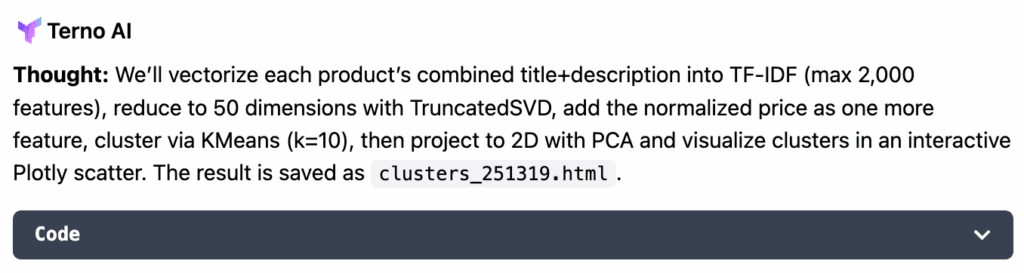
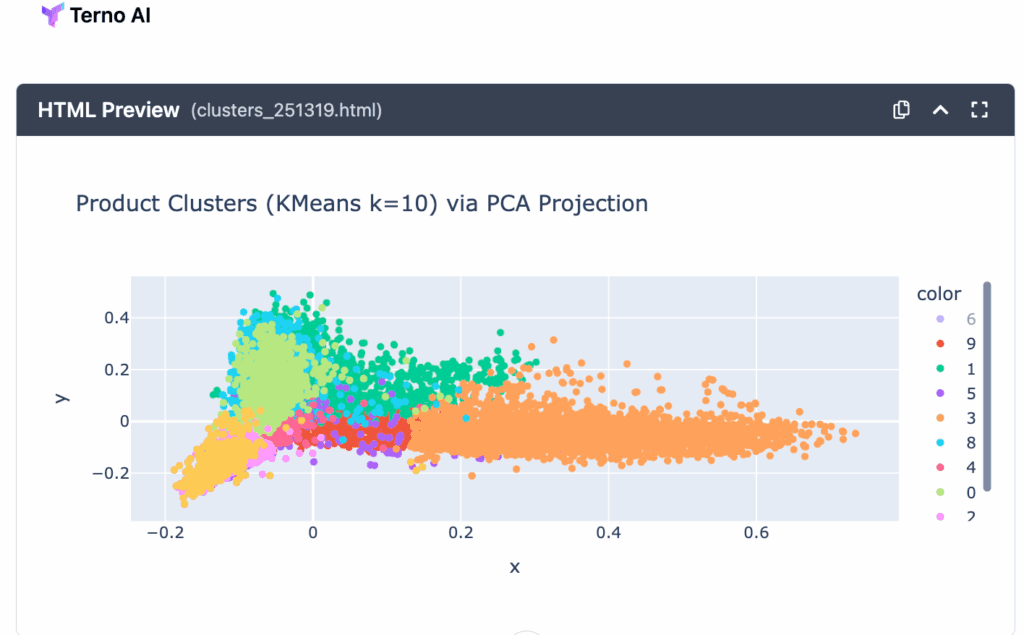
Products were clustered using:
TF-IDF features (reduced with SVD)
MRP normalized
K-Means (k=10)
Visualized with PCA/t-SNE plots
Clusters naturally grouped items into categories like lip care, shampoos, fragrances, and skincare—offering insights for catalog structuring and competitive positioning.
11. From Product Analysis to FMCG Automation
Prompt:
“Summarize the feasibility and quality of automated product classification and recommendation for this dataset.”

This concluding step evaluates whether AI solutions are practically viable using the dataset. It highlights challenges like inconsistent data quality or opportunities like strong brand categorization. For real-world decisions, this insight helps businesses decide on AI adoption strategy—whether to invest further in automation or to improve data collection first.
Insight:
Classification: Strong potential for brand and sub-category tagging, though fine-grained classes need advanced handling.
Recommendation: High-quality out-of-the-box with TF-IDF + price.
Clustering: Useful for catalog curation, competitive mapping, and identifying under-served niches.
Conclusion
This exercise shows how Terno AI can unlock machine learning capabilities for FMCG datasets:
Sub-Category classification is achievable with careful handling of class imbalance.
Brand prediction is highly accurate, making it ideal for catalog hygiene.
Product recommendations work well using simple TF-IDF + price blending.
Clustering visualizations reveal natural product groupings for merchandising strategy.
For retailers like BigBasket, these pipelines can drive better personalization, faster catalog management, and sharper competitive insights—all powered by Terno AI.
👉 Dataset & Prompts explored via Terno AI: Conversation Link

10 September 2026
Designing CertusAI: A Compliance-First Enterprise LLM Platform for Regulated Industries
As enterprise adoption pivots from raw model parameter scale to verifiable trust, CertusAI introduces a compliance-first LLM architecture engineered specifically for highly regulated industries. By integrating real-time PII redaction, deterministic policy enforcement, and cryptographically signed audit chains directly into the inference pipeline, CertusAI unlocks agentic AI productivity while ensuring total data sovereignty and statutory compliance.

10 September 2026
E-Commerce Return Intelligence: Analyzing Return Drivers and Predicting Purchase-Time Return
Addressing reverse-logistics friction and return-rate costs in fashion e-commerce, this study leverages the 1.37M-record ASOS GraphReturns dataset to evaluate product, pricing, and country-level return drivers. Using Terno AI for structured analysis alongside a deployed Logistic Regression baseline, the platform provides purchase-time risk scoring to power relative risk ranking, operational prioritization, and non-punitive intervention pilots.
10 September 2026
Global Food Loss Intelligence: Strategic Screening & Decision Framework
An executive decision-support whitepaper translating the official FAO Food Loss Index (SDG Indicator 12.3.1a) into actionable intelligence for 2021–2023. This study establishes a data-driven monitoring baseline across major commodity groups, identifying Fruits & Vegetables (3-year mean index of 109.65) as the primary priority for diagnostic follow-up while offering structured strategies for public policy, industry benchmarking, and evidence-based resource allocation.