
Executive Summary
As Artificial Intelligence transitions from experimental pilot programs into core enterprise infrastructure, organizations operating within highly regulated sectors—including healthcare, banking, financial services, government, legal services, and critical infrastructure—face significant friction in adopting Large Language Models (LLMs). While public and commercial foundational models exhibit remarkable general reasoning capabilities, they regularly fail to satisfy stringent regulatory compliance frameworks, operational transparency requirements, immutable cryptographic auditability, and granular data governance protocols.
This research presents an exhaustive comparative analysis of leading enterprise LLM providers—such as OpenAI, Anthropic, Google, Meta, Mistral AI, and DeepSeek—to identify systemic market gaps from a compliance and regulatory standpoint. Based on these findings, we introduce CertusAI, a compliance-first enterprise LLM platform engineered specifically to satisfy global regulatory frameworks including GDPR, HIPAA, SOC 2, ISO 27001, and the EU AI Act. The platform encompasses competitive benchmarking, gap analysis, MVP design, RICE-based feature prioritization, a 24-month product execution roadmap, and a long-term commercial evaluation. The findings demonstrate that enterprise demand is rapidly pivoting away from raw parameter scale toward trustworthy, transparent, and regulation-ready AI systems.
Modern enterprise adoption requires a fundamental shift in how Large Language Model platforms are architected. Traditional cloud AI deployments treat safety and compliance as superficial, post-hoc processing wrappers layered on top of black-box inference APIs. In contrast, CertusAI integrates compliance verification, token masking, deterministic policy enforcement, and audit logging directly into the core generation pipeline. By grounding every response in verifiable retrieval-augmented sources and cryptographically logging every system transaction, CertusAI enables risk-averse institutions to unlock the transformative productivity gains of agentic AI workflows while remaining fully compliant with global statutory requirements.
1. Introduction & Market Dynamics
Large Language Models (LLMs) have fundamentally altered modern enterprise productivity through automated document analysis, code generation, complex report synthesis, and intelligent agentic workflows. Leading AI research labs continue to push the boundaries of foundational intelligence, expanding reasoning depth, context window capacities, and multimodal capabilities. However, deploying general-purpose LLMs within highly regulated domains introduces severe operational, financial, and legal risks that standard commercial API offerings fail to resolve.
The primary barrier to enterprise adoption lies in data privacy, sovereignty, and data leakage risks. Transmitting proprietary customer financial records, confidential legal filings, or protected health information (PHI) across public cloud APIs creates immense exposure regarding data breach liabilities, third-party data persistence, and unauthorized model retraining. Standard cloud API agreements frequently lack legally binding guarantees against downstream telemetry logging or cross-tenant data exposure in shared GPU clusters. For organizations handling sensitive intellectual property or strictly regulated personal data, public cloud inference endpoints remain an unacceptable risk vector.
Furthermore, explainability and hallucination liabilities severely limit real-world enterprise deployment. Probabilistic token generation inherently lacks native deterministic grounding. In high-stakes operational environments—such as clinical diagnostic support, financial regulatory compliance, or corporate legal analysis—"black-box" outputs delivered without explicit source provenance create unacceptable operational liabilities. Organizations cannot risk automated generation where an ungrounded hallucination leads to regulatory non-compliance, financial loss, or civil litigation.
Finally, auditability and traceability remain severely underserved by current commercial infrastructure. Standard API logging mechanisms provide basic request-response metadata tracking, but they fall drastically short of providing the timestamped, cryptographically sealed, and regulator-ready audit chains necessary for formal compliance reviews under mandates such as SOC 2, HIPAA, or the EU AI Act. As global regulatory bodies enforce strict laws governing automated decision systems, corporate purchasing criteria have shifted. Enterprise decision-makers now prioritize platform security, data residency control, model explainability, and governance features over minor incremental gains in public benchmark leaderboards.
2. Research & Analytical Methodology
To move beyond qualitative assumptions, this study applied a data-driven evaluation methodology leveraging the Terno Agentic AI Platform to analyze two comprehensive industry datasets: llm-benchmarks-2026-2.csv, which captures technical accuracy metrics across MMLU, HumanEval, and Math alongside operational input/output pricing ($/1M tokens), and llm-model-comparison-2026-4.csv, which tracks functional enterprise capabilities, licensing models, fine-tuning support, security certifications, and deployment flexibility.
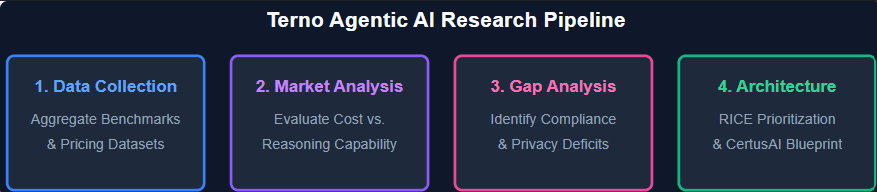
Our analytical framework was executed through a structured 4-Stage Research Pipeline on the Terno Agentic AI Platform. Stage 1 focused on Data Collection and Normalization, where raw benchmark telemetry was aggregated, cleaned, and relationally joined across commercial closed-source APIs and open-weights models to establish a unified comparative baseline across technical reasoning metrics and operational running costs. This ensured that model performance could be directly evaluated against the economic cost of deployment.
Stage 2 comprised Market Segmentation Analysis, categorizing models by parameter scale, deployment model, licensing constraints, and enterprise-readiness classifications. This step allowed us to inspect economic trade-offs, evaluating cost efficiency against raw intelligence and determining whether premium enterprise pricing correlates directly with higher regulatory safety or simply broader general capability. By isolating cost structures, we quantified the financial markup enterprise buyers pay for commercial wrapper services.
Stage 3 executed Gap Analysis and Boundary Identification, mapping current market capabilities directly against global compliance mandates (including GDPR, HIPAA, SOC 2, ISO 27001, and the EU AI Act). By identifying where commercial providers failed to provide full cryptographic logging, local data sovereignty, or deterministic guardrails, we explicitly framed the market void that a specialized platform must fill.
Stage 4 focused on Solution Architecture and Product Planning, translating these quantitative gaps into functional platform blueprints. Using the RICE framework, we scored potential platform capabilities, prioritized the Minimum Viable Product (MVP) scope, and formulated a comprehensive 24-month strategic execution roadmap for CertusAI. This systematic approach ensured that every feature in the proposed architecture directly addresses a quantified market gap identified during data analysis.
3. Competitive Landscape & Feature Gap Analysis
Our empirical analysis indicates that several core LLM capabilities have fully transitioned into baseline industry expectations ("table stakes"). Multimodal perception, function calling, tool utilization, structured JSON outputs, and response streaming are now universally expected across nearly all foundational models. However, true enterprise compliance features—such as zero-retention guarantees, verifiable provenance tracking, and air-gapped open-source customization—remain severely underprovided by established players.
| Capability | Standard Industry Feature? | Still a Major Differentiator? | Market Investment Focus | Identified Market Gap? |
|---|---|---|---|---|
| Multimodal Perception | Yes | No | Universal across providers | No |
| Function Calling & Tool Use | Yes | No | Most commercial providers | No |
| Structured Output (JSON Mode) | Yes | No | Universal across providers | No |
| Streaming Responses | Yes | No | Universal across providers | No |
| Basic Enterprise Readiness | Yes | No | OpenAI, Google, Anthropic | Affordable, Open Source |
| Fine-Tuning Support | Yes | Partial | Selected Enterprise Providers | Deep Open Source Control |
| Compliance-First Architecture | No | Yes (Core Moat) | CertusAI Core Target | Major Market Gap |
Evaluating models grouped by their enterprise readiness designations reveals critical cost-to-performance trade-offs. Non-Enterprise and Open-Weights models demonstrate surprisingly strong technical reasoning benchmarks, boasting an average MMLU score of 86.10, HumanEval score of 84.48, and Math benchmark score of 84.13. Their economic footprint is extraordinarily low, averaging just $0.28 per 1M input tokens and $1.06 per 1M output tokens. However, these models lack out-of-the-box compliance controls, native SSO/RBAC integration, and enforceable enterprise SLAs, requiring significant internal engineering to make them safe for production deployment.
Conversely, Enterprise-Ready commercial models maintain comparable technical benchmark scores—averaging 83.24 on MMLU, 86.58 on HumanEval, and 76.66 on Math—while charging significantly higher rates. On average, commercial enterprise models cost $1.59 per 1M input tokens and $7.60 per 1M output tokens (representing a ~5x to 7x cost markup). Despite this premium pricing, commercial vendors still fail to offer total deployment sovereignty, leaving sensitive organizations dependent on third-party cloud trust models.
Evaluating leading market providers against strict regulatory requirements confirms that existing commercial solutions treat compliance as an external wrapper rather than a core architectural foundation. The matrix below highlights key functional capabilities across major providers compared to the target specifications for CertusAI:
| Provider / Platform | Data Privacy & Security | Regulatory Compliance | Explainability & Transparency | Auditability & Reporting | Integration (API, SSO, RBAC) | Human-in-the-Loop Review |
|---|---|---|---|---|---|---|
| OpenAI | Partial | Partial | Limited | Partial | Full | Limited |
| Anthropic | Partial | Partial | Partial | Partial | Full | Limited |
| Partial | Partial | Partial | Partial | Full | Limited | |
| Meta | Limited | Limited | Limited | Not Available | Partial | Not Available |
| Mistral AI | Limited | Limited | Limited | Not Available | Partial | Not Available |
| DeepSeek | Limited | Limited | Limited | Not Available | Partial | Not Available |
| CertusAI (Target) | Full | Full | Full | Full | Full | Full |
This comparison underscores the central thesis of our research: while existing commercial providers excel at raw benchmark reasoning, they leave substantial compliance gaps. CertusAI addresses this exact market vacancy by offering end-to-end data isolation, deterministic guardrails, and cryptographic transparency out of the box.
4. Introducing CertusAI: Proposed Solution Architecture
CertusAI is a compliance-first enterprise Large Language Model platform designed specifically for highly regulated deployment environments. Rather than treating governance as an external post-processing step, CertusAI integrates security, auditability, and regulatory policy execution directly into every layer of its inference and data pipelines. The platform acts as an intelligent, policy-enforcing mediation layer between enterprise users, corporate data stores, and foundational models.
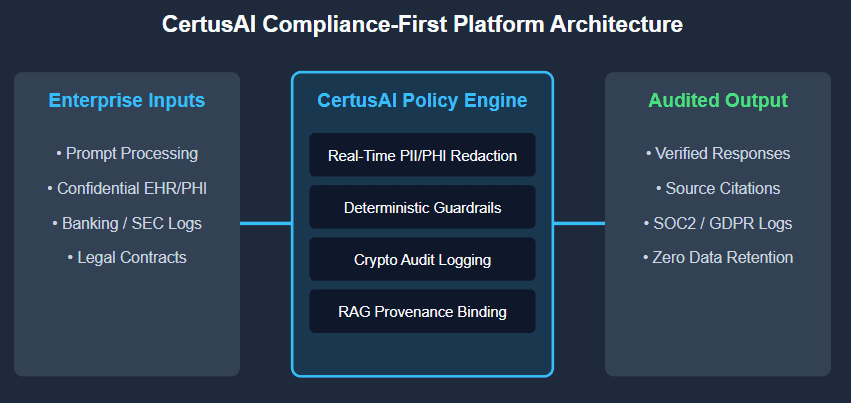
Privacy-First Deployment Flexibility: CertusAI provides absolute data isolation across deployment modes. Enterprises can deploy the platform in fully air-gapped on-premises data centers, isolated Virtual Private Clouds (VPCs), or regional sovereign cloud infrastructure. This guarantees that prompt text, model activations, and vector embeddings remain within the organization's legal perimeter with zero telemetry leakage.
Compliance by Design Engine: Operating directly within the token stream, CertusAI executes real-time inspection and sanitization. PII (Personally Identifiable Information) and PHI (Protected Health Information) are dynamically detected, masked, and redacted before token processing. Deterministic output guardrails actively block non-compliant content, while pre-configured policy templates enforce standards for GDPR, HIPAA, SOC 2, ISO 27001, and the EU AI Act.
Explainable AI & Provenance Tracking: To resolve "black-box" generative liability, CertusAI enforces strict Retrieval-Augmented Generation (RAG) binding. Every claim generated by the system is mapped directly to underlying enterprise documents with interactive source citation trees. Reasoning paths are visually rendered, enabling compliance officers to audit model logic step-by-step and track real-time safety, bias, and drift evaluations.
Enterprise Governance & Control: Platform governance is operationalized through immutable, cryptographically signed audit logs capturing every user prompt, model response, and system intervention. Fine-grained Role-Based Access Control (RBAC) integrates with enterprise Identity Providers (Okta, Azure AD), while customizable human-in-the-loop (HITL) review queues automatically route low-confidence outputs to human compliance managers prior to final execution.
Through this integrated architecture, CertusAI transforms LLM deployment from an unmanaged compliance risk into a fully controlled, enterprise-grade business asset. Organizations gain the productivity benefits of advanced generative workflows without sacrificing security or regulatory standing.
5. RICE Feature Prioritization Framework
To maximize engineering efficiency, optimize capital allocation, and ensure rapid time-to-market for our Minimum Viable Product (MVP), proposed platform capabilities were systematically evaluated using the RICE feature prioritization methodology:
RICE Score = (Reach * Impact * Confidence) / Effort
Each capability was scored across four operational dimensions: Reach (scale of 1–10, measuring the percentage of target enterprise personas positively impacted), Impact (scale of 1–5, evaluating direct compliance and commercial value delivered), Confidence (percentage score, reflecting technical feasibility and engineering certainty), and Effort (scale of 1–10, estimating engineering month-hours required for implementation).
| Feature / Capability Module | Reach | Impact | Confidence | Effort | RICE Score | Strategic Priority |
|---|---|---|---|---|---|---|
| Enterprise Data Privacy & Security Suite | 9 | 5 | 95% | 6 | 7.13 | Must Have (MVP Core) |
| Regulatory Compliance Policy Engine | 8 | 5 | 90% | 7 | 5.14 | Must Have (MVP Core) |
| Explainability & Provenance Suite | 7 | 4 | 85% | 6 | 3.97 | Must Have (MVP Core) |
| Secure Integration & API Gateway | 8 | 4 | 90% | 8 | 3.60 | Must Have (MVP Core) |
| Domain Adaptation & Customization | 6 | 4 | 80% | 7 | 2.74 | Should Have (Phase 2) |
| Usage Analytics & Cost Governance | 6 | 3 | 80% | 7 | 2.06 | Should Have (Phase 2) |
| Human-in-the-Loop Review Queues | 5 | 3 | 80% | 6 | 2.00 | Should Have (Phase 2) |
| Advanced Reasoning & Hybrid RAG | 4 | 3 | 70% | 8 | 1.05 | Could Have (Phase 3) |
| Multi-Region Sovereign Routing | 3 | 3 | 70% | 7 | 0.90 | Could Have (Phase 3) |
| Bring Your Own Model (BYOM) Layer | 3 | 3 | 70% | 8 | 0.79 | Future Expansion |
The quantitative evaluation established a clear hierarchy for development. High-scoring modules—such as the Enterprise Data Privacy & Security Suite (7.13), Regulatory Compliance Policy Engine (5.14), Explainability Suite (3.97), and Secure Integration Gateway (3.60)—demonstrated high impact and feasibility relative to engineering effort. These four modules constitute the mandatory foundation of the Core MVP.
Secondary features, including Domain Adaptation (2.74), Usage Analytics (2.06), and Human-in-the-Loop Review Queues (2.00), were designated as "Should Have" capabilities for Phase 2. Lower-scoring optimizations like Sovereign Routing (0.90) and BYOM Layer (0.79) were scheduled for later expansion, ensuring engineering resources remain strictly aligned with high-value regulatory requirements during initial product execution.
6. Strategic 24-Month Execution Roadmap
Building a regulation-ready enterprise platform requires a disciplined, phased development strategy. CertusAI’s expansion is organized across four distinct 6-month product development phases:
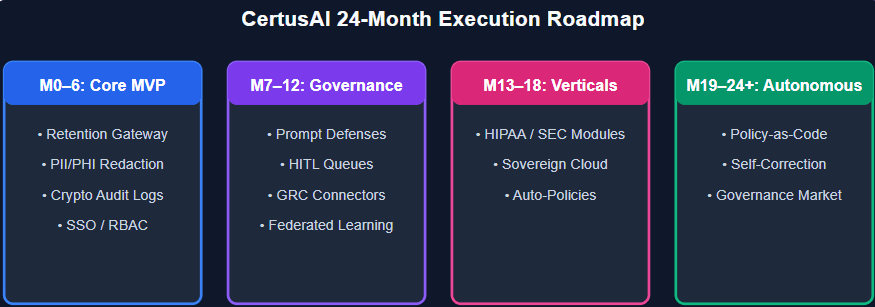
Phase 1: Core MVP & Security Foundation (Months 0–6)
├── Deploy zero-retention API gateways & FIPS 140-2 encryption (at-rest/in-transit).
├── Build automated PII/PHI redaction & static compliance policy guardrails.
├── Implement cryptographically sealed audit logging & RAG provenance visualization.
└── Deliver enterprise SSO connectors (SAML/OIDC) & fine-grained RBAC models.
Phase 2: Risk Management & Advanced Governance (Months 7–12)
├── Roll out real-time prompt injection defenses & automated hallucination scoring.
├── Deploy customizable Human-in-the-Loop (HITL) approval queues for high-risk workflows.
├── Integrate natively with enterprise GRC platforms (ServiceNow, OneTrust).
└── Enable federated learning connectors for secure localized model fine-tuning.
Phase 3: Domain Specialization & Sovereign Expansion (Months 13–18)
├── Release specialized compliance packs (HIPAA/FDA, FINRA/SEC Rule 17a-4, Public Sector).
├── Launch multi-region sovereign cloud hosting with regional data routing.
└── Deploy auto-updating policy engines responding to shifting global AI laws.
Phase 4: Autonomous Compliance & Leadership (Months 19–24+)
├── Roll out Policy-as-Code orchestration for declarative compliance management.
├── Implement self-correcting inference chains with automated claim verification.
└── Launch the CertusAI Governance Marketplace for third-party guardrail distribution.
Phase 1 focuses on core security, zero-retention API gateways, hardware-enforced encryption, and the core Regulatory Compliance Toolkit.
Phase 2 expands platform risk management with active threat monitoring, prompt injection prevention, hallucination scoring, and GRC platform integrations.
Phase 3 introduces specialized compliance modules for Healthcare, Finance, and Legal sectors, alongside sovereign cloud deployment options.
Phase 4 completes the vision by introducing autonomous Policy-as-Code orchestration, self-correcting inference chains, and a community governance marketplace.
7. Commercial Impact, Industry Applications & Market Positioning
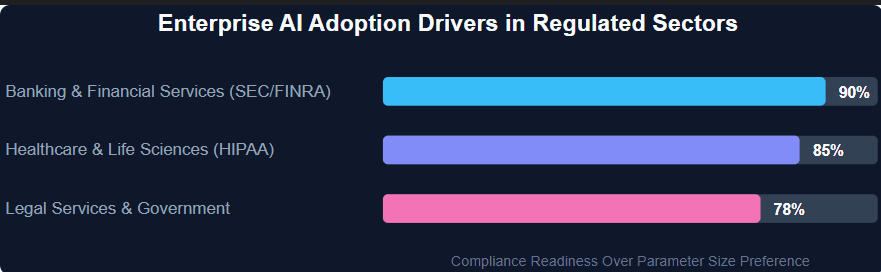
The commercial opportunity for CertusAI spans several high-value, highly regulated enterprise sectors where public LLM adoption remains stalled due to strict statutory oversight:
In Banking, Financial Services, and Insurance (BFSI), CertusAI enables automated compliance auditing of marketing materials, investor communications, and advisory transcripts under SEC Rule 17a-4 and FINRA guidelines. Financial institutions can securely parse complex loan applications, mortgage portfolios, and insurance underwriting claims in isolated private environments without risk of third-party data retention. Furthermore, compliance teams can automate anti-money laundering (AML) report synthesis with complete audit logging.
In Healthcare and Life Sciences, the platform bridges the gap between AI automation and patient privacy. Healthcare providers can deploy CertusAI for HIPAA-compliant summaries of Electronic Health Records (EHR) and physician consultation notes. Pharmaceutical companies can accelerate clinical trial protocol generation and medical research analysis while maintaining absolute data segregation and strict PHI masking.
In Legal Services and the Public Sector, CertusAI accelerates high-speed document discovery, contract clause risk scoring, and regulatory cross-filing analysis. Government agencies operating within air-gapped perimeters can automate public record request processing and policy synthesis under strict sovereign data residency mandates.
To address commercial risks such as extended procurement cycles (6 to 12 months), CertusAI provides pre-configured, SOC 2 compliant "sandbox environments" that enable enterprise security teams to complete technical audits within weeks. To navigate rapidly changing global AI laws, a dedicated legal-tech engineering team delivers continuous Policy-as-Code compliance updates via subscription services, ensuring ongoing operational compliance for all enterprise clients.
8. Conclusion & Future Outlook
The findings of this research emphasize that long-term enterprise value in Artificial Intelligence will not belong solely to providers with the largest parameter counts or the highest raw benchmark scores. Instead, market leadership will belong to platforms that successfully establish verifiable trust, deterministic safety guardrails, and seamless regulatory compliance.
As automated decision systems face increasing scrutiny from global regulators, enterprise buyers are actively rejecting opaque black-box AI services in favor of platforms that offer complete data sovereignty, cryptographic auditability, and explainable inference logic. CertusAI demonstrates that embedding governance directly into the inference pipeline creates a durable competitive moat while unlocking enterprise workflows that were previously off-limits due to regulatory risk.
By bridging the gap between foundational AI capabilities and the strict compliance mandates of regulated industries, CertusAI establishes a scalable roadmap for trustworthy enterprise automation. As the platform evolves toward autonomous governance and Policy-as-Code orchestration, it will continue to empower risk-averse institutions to deploy cutting-edge AI systems with total confidence, safety, and regulatory compliance.
References
Bommasani, R., et al. (2021). On the Opportunities and Risks of Foundation Models. Stanford Center for Research on Foundation Models (CRFM).
Brown, T., et al. (2020). Language Models are Few-Shot Learners. Advances in Neural Information Processing Systems (NeurIPS).
European Parliament (2024). Artificial Intelligence Act (EU AI Act). Official Journal of the European Union.
ISO/IEC (2022). ISO/IEC 27001:2022 Information Security, Cybersecurity and Privacy Protection.
National Institute of Standards and Technology (NIST) (2023). Artificial Intelligence Risk Management Framework (AI RMF 1.0).
OWASP Foundation (2025). OWASP Top 10 for Large Language Model Applications.

10 September 2026
E-Commerce Return Intelligence: Analyzing Return Drivers and Predicting Purchase-Time Return
Addressing reverse-logistics friction and return-rate costs in fashion e-commerce, this study leverages the 1.37M-record ASOS GraphReturns dataset to evaluate product, pricing, and country-level return drivers. Using Terno AI for structured analysis alongside a deployed Logistic Regression baseline, the platform provides purchase-time risk scoring to power relative risk ranking, operational prioritization, and non-punitive intervention pilots.

10 September 2026
Optimizing Schedule Integrity via Patient Appointment Intelligence
Most patient no-show models look impressive on paper until they hit production. By rejecting target leakage, confronting a heavy 90/10 class imbalance head-on, and moving beyond raw accuracy, we built a production-ready decision layer that converts raw risk probabilities into actionable clinical interventions.

10 September 2026
Global Food Loss Intelligence: Strategic Screening & Decision Framework
An executive decision-support whitepaper translating the official FAO Food Loss Index (SDG Indicator 12.3.1a) into actionable intelligence for 2021–2023. This study establishes a data-driven monitoring baseline across major commodity groups, identifying Fruits & Vegetables (3-year mean index of 109.65) as the primary priority for diagnostic follow-up while offering structured strategies for public policy, industry benchmarking, and evidence-based resource allocation.